Porisma

Worked solution

Question 4

The curve C1C_1 has equation (x−1)2−y2=1(x-1)^2-y^2=1 and the curve C2C_2 has equation y=1216−x2y=\dfrac12\sqrt{16-x^2}.

(i) Sketch C1C_1 and C2C_2 on the same diagram, indicating clearly the axial intercepts and the equations of any asymptotes. marks

(ii) Find the xx-coordinate(s) of the point (s) of intersection of C1C_1 and C2C_2. mark

(iii) Hence solve the inequality 2(x−1)2−1<16−x22\sqrt{(x-1)^2-1}<\sqrt{16-x^2}. marks

2014/SRJC/JC1/MYE/4

Answer

(i) C1C_1 is a hyperbola with centre (1,0)(1,0), meeting the axes only at (0,0)(0,0) and (2,0)(2,0), with asymptotes y=x−1y=x-1 and y=−x+1y=-x+1. C2C_2 is the upper half of the ellipse x216+y24=1\dfrac{x^2}{16}+\dfrac{y^2}{4}=1, meeting the axes at (−4,0)(-4,0), (4,0)(4,0) and (0,2)(0,2).

(ii) x=−1.16x=-1.16 or x=2.76x=2.76.

(iii) −1.16<x≤0-1.16<x\le0 or 2≤x<2.762\le x<2.76.

Compare your reasoning

(ii) Setting (x−1)2−1=16−x24(x-1)^2-1=\dfrac{16-x^2}{4} gives 5x2−8x−16=05x^2-8x-16=0, so x=8±38410x=\dfrac{8\pm\sqrt{384}}{10}, which is −1.16-1.16 or 2.762.76 to 3 significant figures.

(iii) Dividing by 2, the inequality says the upper branch of C1C_1, y=(x−1)2−1y=\sqrt{(x-1)^2-1}, lies below C2C_2. That branch exists only for x≤0x\le0 or x≥2x\ge2, and it lies below C2C_2 between the two intersections.

The exact intersection abscissae are r−=(4−46)/5r_-=(4-4\sqrt6)/5 and r+=(4+46)/5r_+=(4+4\sqrt6)/5. The exact inequality solution is (r−,0]∪[2,r+)(r_-,0]\cup[2,r_+); −1.16-1.16 and 2.762.76 are the source’s three-significant-figure boundary labels, not exact endpoints.

How did this question go?

Compare your sketch

Expand diagram

Use the scrollbars or arrow keys to inspect details.
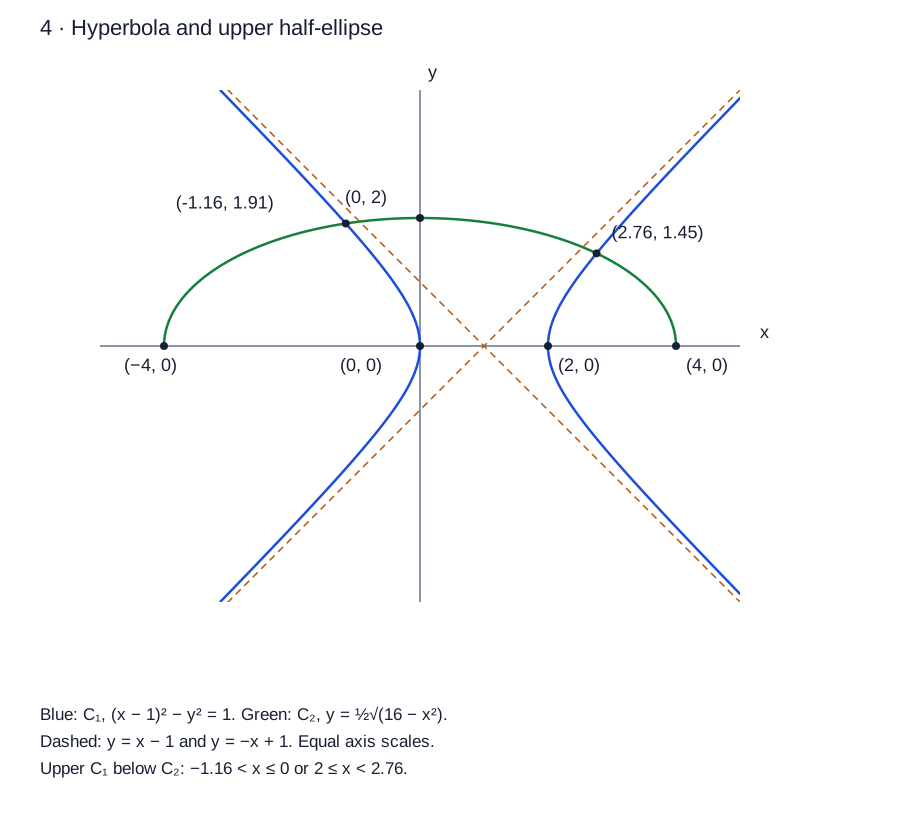
Full hyperbola (x − 1)² − y² = 1 has vertices (0, 0), (2, 0) and asymptotes y = x − 1 and y = −x + 1. Upper half-ellipse y = (1/2)√(16 − x²) has intercepts (−4, 0), (4, 0), (0, 2). Upper intersections are approximately (−1.16, 1.91) and (2.76, 1.45).