Porisma

Worked solution

Question 6

(a) The curve C1C_1 has equation (x+2)222−y232=1\dfrac{(x+2)^2}{2^2}-\dfrac{y^2}{3^2}=1. Sketch C1C_1, giving the equations of any asymptotes, coordinates of its centre and the vertices. marks

(b) The curve C2C_2 has equation y=3x2+12x+λ2(x+2)y=\dfrac{3x^2+12x+\lambda}{2(x+2)}, x≠−2x\ne-2, λ∈R\lambda\in\mathbb R, λ≠12\lambda\ne12. Find the range of values of λ\lambda for which the graph of C2C_2 is strictly increasing. marks

2016/Promo/NYJC/5

Answer

(a) The centre is (−2,0)(-2,0) and the vertices are (0,0)(0,0) and (−4,0)(-4,0). The asymptotes are y=32x+3y=\tfrac32x+3 and y=−32x−3y=-\tfrac32x-3.

(b) λ<12\lambda<12.

Compare your reasoning

(a) The asymptotes pass through the centre with gradient ±32\pm\dfrac32: y=±32(x+2)y=\pm\tfrac32(x+2).

(b) y=32(x+2)+λ−122(x+2)y=\tfrac32(x+2)+\dfrac{\lambda-12}{2(x+2)}, so

dydx=32−λ−122(x+2)2.\begin{aligned}&\frac{dy}{dx}\\ & =\frac32-\frac{\lambda-12}{2(x+2)^2}.\end{aligned}

For dydx>0\dfrac{dy}{dx}>0 we need 3(x+2)2−(λ−12)>03(x+2)^2-(\lambda-12)>0 for every x≠−2x\ne-2. Since (x+2)2(x+2)^2 can be arbitrarily close to 0, this requires −(λ−12)≥0-(\lambda-12)\ge0, and λ≠12\lambda\ne12, so λ<12\lambda<12.

Method 2 (the source’s quotient-rule alternative): dydx=2(x+2)(6x+12)−2(3x2+12x+λ)[2(x+2)]2=3x2+12x+24−λ2(x+2)2.\begin{aligned}&\frac{dy}{dx}\\ & =\frac{2(x+2)(6x+12)-2(3x^2+12x+\lambda)}{[2(x+2)]^2}\\ & =\frac{3x^2+12x+24-\lambda}{2(x+2)^2}.\end{aligned} The numerator is 3(x+2)2+12−λ3(x+2)^2+12-\lambda. For λ<12\lambda<12 it is positive everywhere, equivalently its discriminant is 122−4(3)(24−λ)=12(λ−12)<012^2-4(3)(24-\lambda)=12(\lambda-12)<0. The source’s line “for all x≠2x\ne2” should read x≠−2x\ne-2. The excluded case λ=12\lambda=12 would also have positive derivative on its domain. Here “strictly increasing” means separately on (−∞,−2)(-\infty,-2) and (−2,∞)(-2,\infty), as in the printed derivative argument: across the gap, values on the left tend to +∞+\infty while values on the right tend to −∞-\infty, so there is no global increasing order on the disconnected domain.

How did this question go?

Compare your sketch

Expand diagram

Use the scrollbars or arrow keys to inspect details.
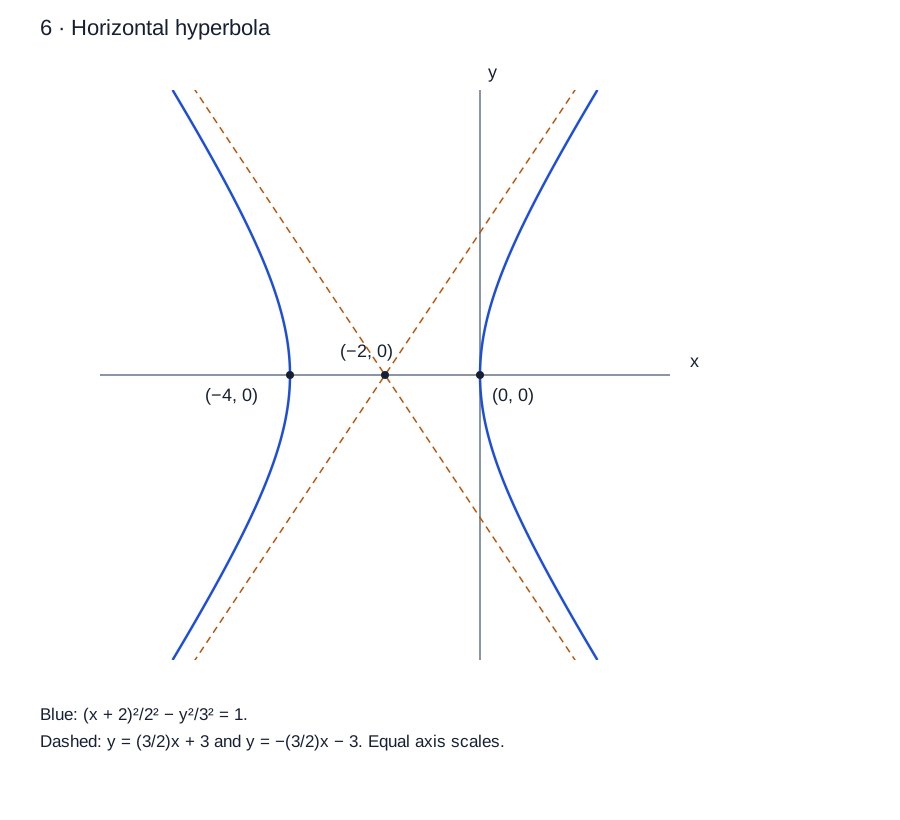
Hyperbola centred at (−2, 0), with vertices (−4, 0) and (0, 0), asymptotes y = (3/2)x + 3 and y = −(3/2)x − 3. Branches open left and right.