Porisma

Worked solution

Question 7

A tunnel is built to facilitate the transportation of goods by trains between Country XX and Country YY. Due to differences in the rail systems between the two countries, two types of tracks are used: the international track with track gauge of 1435 mm and the narrow track with track gauge of 1000 mm (in rail transport, track gauge is the spacing on a railway track). It is known that the cross-section of the tunnel is a half ellipse with centre OO and width MNMN. The maximum height of the tunnel is 2000 mm. To standardize the volumes of the goods to be transported, the areas ABCDABCD and EFGHEFGH are made equal. Find the width of the tunnel MNMN, giving your answer to the nearest mm.

In the diagram, OO is the midpoint of the base MNMN. AA and BB lie on the base, 1000 mm apart and symmetric about OO, with DD and CC on the tunnel wall directly above them. EE and FF lie on the base, 1435 mm apart and symmetric about OO, with HH and GG on the tunnel wall directly above them.

Expand diagram

Use the scrollbars or arrow keys to inspect details.
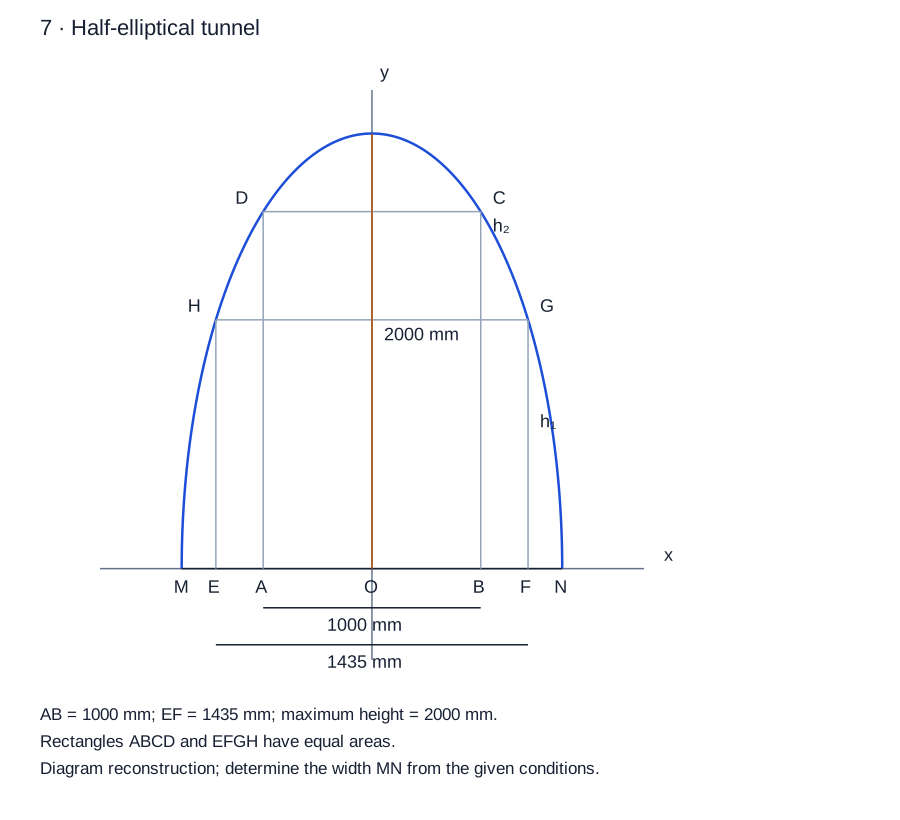
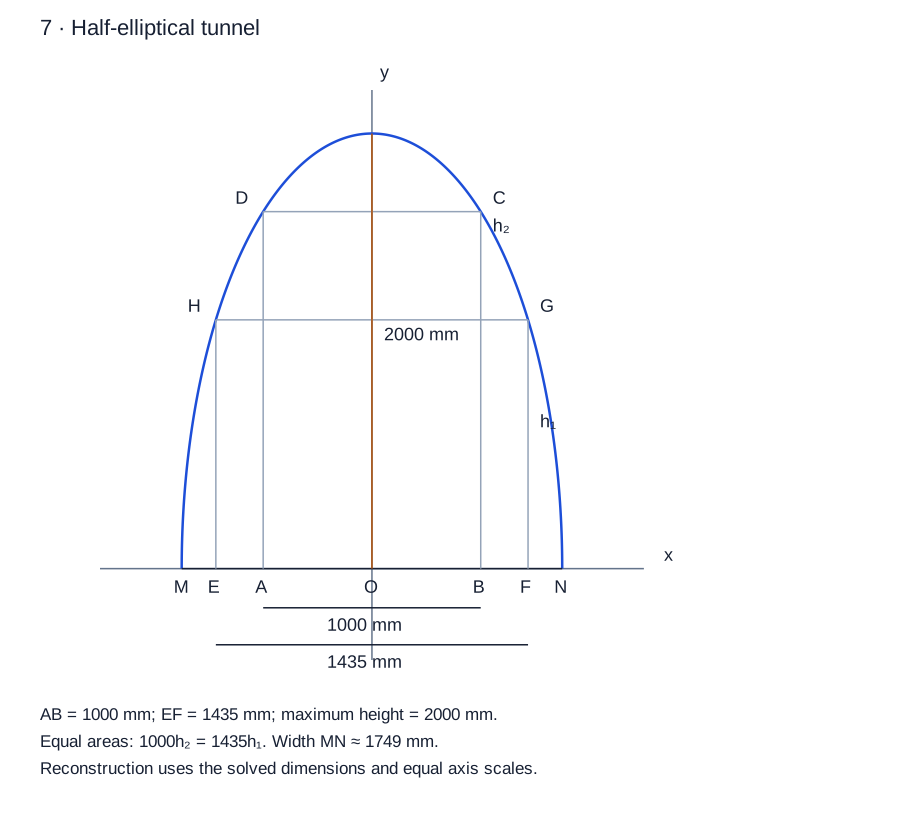
Half ellipse of maximum height 2000 mm and base MN, centred at O. Along the base from left to right are M, E, A, O, B, F, N. A and B are 1000 mm apart; E and F are 1435 mm apart. D and C are vertically above A and B; H and G above E and F. Rectangles ABCD and EFGH have equal areas. BC = h₂ and FG = h₁.

2015/HCI/Prelim/I/3

Answer

MN≈1749MN\approx1749 mm.

Compare your reasoning

Let FG=h1FG=h_1 and BC=h2BC=h_2, and take the ellipse x2a2+y220002=1\dfrac{x^2}{a^2}+\dfrac{y^2}{2000^2}=1, so MN=2aMN=2a.

Equal areas: 1000h2=1435h11000h_2=1435h_1, so h2=1.435h1h_2=1.435h_1.

G(717.5, h1)G\left(717.5,\,h_1\right) is on the ellipse: 717.52a2+h1220002=1\dfrac{717.5^2}{a^2}+\dfrac{h_1^2}{2000^2}=1.

C(500, h2)C\left(500,\,h_2\right) is on the ellipse: 5002a2+(1.435h1)220002=1\dfrac{500^2}{a^2}+\dfrac{(1.435h_1)^2}{2000^2}=1.

Solving the two equations gives a2=764806.25a^2=764806.25, so a=874.532a=874.532 and MN=2a=1749.06≈1749MN=2a=1749.06\approx1749 mm.

How did this question go?

Compare your sketch

Expand diagram

Use the scrollbars or arrow keys to inspect details.
Half ellipse of maximum height 2000 mm and base MN, centred at O. Along the base from left to right are M, E, A, O, B, F, N. A and B are 1000 mm apart; E and F are 1435 mm apart. D and C are vertically above A and B; H and G above E and F. Rectangles ABCD and EFGH have equal areas. BC = h₂ and FG = h₁.