Review practice · Section 2 of 3
Questions 7–12 in this collection
Reuse a square root before undoing a scale and translation · Read cubic roots and rotate roots of a complex quadratic · +4 more
- 7
A graphic calculator is not to be used in answering this question.
Express in the form . Hence find the roots of . marks
[2009/MJC/I/7(a)]
CJC · Review problems · Question 7
- 8
Do not use a graphic calculator in answering this question.
(a) The diagram shows for a cubic polynomial with real coefficients. What can be said about all roots of ? marks
(b) The equation , where is a nonzero real number, has a root . Show that and determine the other root in Cartesian form. Hence find the roots of . marks
Expand diagramFit diagram to page
Use the scrollbars or arrow keys to inspect details.
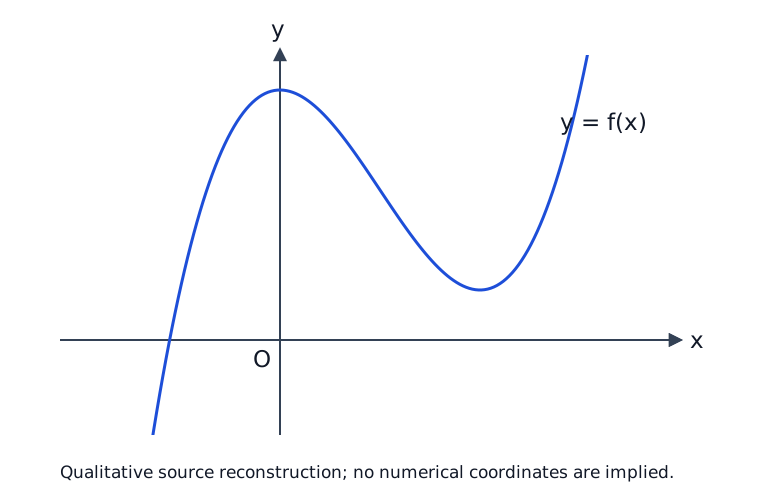
Qualitative cubic sketch with an increasing right-hand end and decreasing left-hand end. It crosses the x-axis once on the negative side, has a local maximum on the y-axis above the x-axis, then a local minimum to the right that also stays above the x-axis. Neither turning point touches the axis. The axes have no numerical scales. [2017/DHS/I/8(a),(b)]
CJC · Review problems · Question 8
- 9
(a) The complex numbers satisfy and . Find and . marks
(b)(i) Given that is a root of , find the second root in Cartesian form, showing your working. marks
(b)(ii) Hence find the roots of . marks
[2017/CJC/II/4(a),(b)]
CJC · Review problems · Question 9
- 10
Find the roots of , giving answers in Cartesian form where . marks
[2022/ACJC/II/3(i)]
CJC · Review problems · Question 10
- 11
Without the use of a calculator, find the complex numbers satisfying and . marks
[2017/SAJC/II/1]
CJC · Review problems · Question 11
- 12
The equation , , has a root with .
(i) Explain clearly why more than one value of is possible. mark
(ii) Find the possible exact values of , show that , and hence find the roots. marks
(iii) Deduce the roots in Cartesian form of (a) and (b) . marks
[2013/DHS/II/4]
CJC · Review problems · Question 12