Discussion questions · Section 2 of 2
Questions 7–12 in this collection
Recover a logarithmic series from a differential identity · Build a shifted-tangent expansion and measure its error · +4 more
- 7
Let .
(i) Show that .
(ii) Find its Maclaurin series through .
(iii) Verify it using the standard series for and .
[2007/CJC/I/7]
CJC · Discussion · Question 7
- 8
Given , show that . Find its series through . When , correct to 8 decimal places. Verify that the fourth-degree estimate has error about .
CJC · Discussion · Question 8
- 9
The curve passes through and satisfies . Find the first three nonzero Maclaurin terms of . Deduce the expansion of through .
[2007/YJC/II/1]
CJC · Discussion · Question 9
- 10
Let . Show that . Hence find its Maclaurin expansion through , and deduce the expansion of through .
[2007/HCI/I/8]
CJC · Discussion · Question 10
- 11
Let for real distinct positive constants .
(i) Show that .
(ii) Hence find the first three nonzero Maclaurin terms in terms of .
(iii) These terms agree with the first three terms of for small . Using MF27, find the exact values of .
[2022/RVHS/II/4(modified)]
CJC · Discussion · Question 11
- 12
In triangle , , radians and radians (see diagram).
(i) Show that .
(ii) For sufficiently small , show that , determining .
Expand diagramFit diagram to page
Use the scrollbars or arrow keys to inspect details.
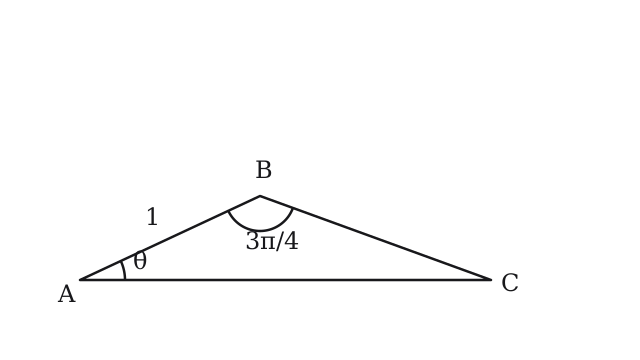
Triangle ABC: A is at the lower left, B above and to its right, and C at the lower right. AB has length 1, angle BAC is theta, and angle ABC is 3 pi/4 radians. The third angle is pi/4 minus theta. [N2012/I/4]
CJC · Discussion · Question 12