Porisma

Worked solution

Approximate a triangle side using radians

In triangle ABCABC, AB=1AB=1, ∠BAC=θ\angle BAC=\theta radians and ∠ABC=3π/4\angle ABC=3\pi/4 radians (see diagram).

(i) Show that AC=1cos⁡θ−sin⁡θAC=\dfrac1{\cos\theta-\sin\theta}.

(ii) For sufficiently small θ\theta, show that AC≈1+aθ+bθ2AC\approx1+a\theta+b\theta^2, determining a,ba,b.

Expand diagram

Use the scrollbars or arrow keys to inspect details.
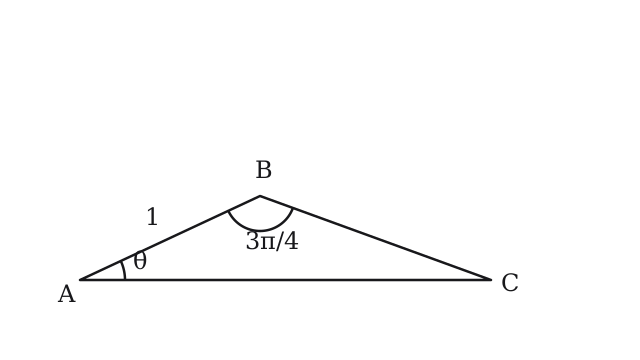
Triangle ABC: A is at the lower left, B above and to its right, and C at the lower right. AB has length 1, angle BAC is theta, and angle ABC is 3 pi/4 radians. The third angle is pi/4 minus theta.

[N2012/I/4]

CJC · Discussion · Question 12

Answer

AC=1/(cos⁡θ−sin⁡θ)≈1+θ+32θ2AC=1/(\cos\theta-\sin\theta)\approx1+\theta+\tfrac32\theta^2; a=1a=1, b=3/2b=3/2.

(i) Apply the sine rule and angle subtraction

∠ACB=π−3π/4−θ=π/4−θ\angle ACB=\pi-3\pi/4-\theta=\pi/4-\theta. By the sine rule, AC/sin⁡(3π/4)=AB/sin⁡(π/4−θ)AC/\sin(3\pi/4)=AB/\sin(\pi/4-\theta). Since AB=1AB=1 and sin⁡(3π/4)=1/2\sin(3\pi/4)=1/\sqrt2,

AC=1/2sin⁡(π/4)cos⁡θ−cos⁡(π/4)sin⁡θ=1cos⁡θ−sin⁡θ.\begin{aligned}&AC\\ & =\frac{1/\sqrt2}{\sin(\pi/4)\cos\theta-\cos(\pi/4)\sin\theta}\\ & =\frac1{\cos\theta-\sin\theta}.\end{aligned}

A nondegenerate triangle requires 0<θ<π/40<\theta<\pi/4.

How did this part go?

(ii) Expand the reciprocal consistently

Using radians, cos⁡θ−sin⁡θ=1−θ−θ2/2+O(θ3)\cos\theta-\sin\theta=1-\theta-\theta^2/2+O(\theta^3). Put u=−θ−θ2/2+O(θ3)u=-\theta-\theta^2/2+O(\theta^3). Then (1+u)−1=1−u+u2+O(u3)=1+θ+θ2/2+θ2+O(θ3)=1+θ+32θ2+O(θ3)(1+u)^{-1}=1-u+u^2+O(u^3)=1+\theta+\theta^2/2+\theta^2+O(\theta^3)=1+\theta+\tfrac32\theta^2+O(\theta^3). Hence a=1a=1, b=3/2b=3/2.

How did this part go?

Common mistakes

The square of the linear term contributes another θ² to the reciprocal expansion.

Read the hint