Porisma
Back to reading

Vectors: magnitude, direction and products

Calculate and check a Cartesian cross product · Diagrams

Cyclic products in a right-handed basis

Use a right-handed orthonormal basis. Every cross-product result is a vector.

i:
+x
j:
+y
k:
+z
Vector results · row first, column second
×ijk
i

0\mathbf0

k\mathbf k

−j-\mathbf j

j

−k-\mathbf k

0\mathbf0

i\mathbf i

k

j\mathbf j

−i-\mathbf i

0\mathbf0

Follow cyclic order

i×j=kj×k=ik×i=j\begin{aligned}\mathbf i\times\mathbf j&=\mathbf k\\\mathbf j\times\mathbf k&=\mathbf i\\\mathbf k\times\mathbf i&=\mathbf j\end{aligned}

Take two consecutive directions in the order i, j, k, then wrap back to i. The result is the remaining positive basis direction. The arrow diagram records this order; the original axes show the spatial directions.

Reverse the order to negate the vector

a×b=−(b×a)\mathbf a\times\mathbf b=-(\mathbf b\times\mathbf a)

Reversing a cyclic pair gives the opposite basis direction. The diagonal products are the zero vector because each direction is parallel to itself; zero has no unit direction.

Compare with the spatial source sketch

Expand diagram

Use the scrollbars or arrow keys to inspect details.
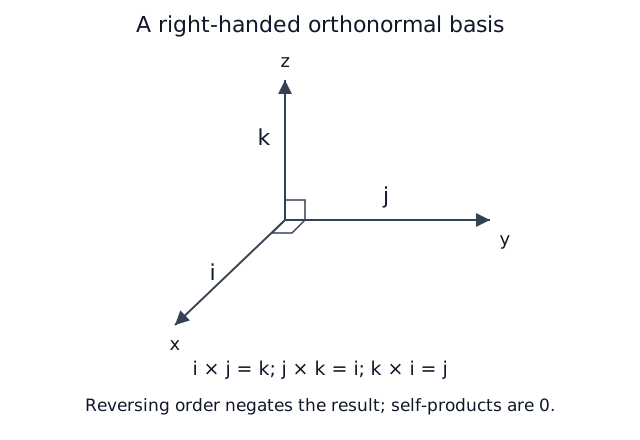
Three spatially perpendicular axes x,y,z carry i,j,k. Positive cyclic products i×j=k, j×k=i, k×i=j; reversing each order negates its result. Self-cross-products are zero. Screen projection is schematic.
Open original diagram (new tab)
Back to reading