Porisma
Back to reading

Vectors: magnitude, direction and products

Calculate scalar products from Cartesian components · Diagrams

Orthonormal basis and scalar products

Use mutually perpendicular unit directions. Every dot-product result is a scalar.

i:
+x
j:
+y
k:
+z
Scalar results · row first, column second
·ijk
i

11

00

00

j

00

11

00

k

00

00

11

Read the diagonal as squared unit lengths

i⋅i=∣i∣2=1\mathbf i\cdot\mathbf i=|\mathbf i|^2=1

Each basis vector has length one, so each diagonal entry is 1.

Read mixed pairs as perpendicular directions

i⋅j=j⋅i=0\mathbf i\cdot\mathbf j=\mathbf j\cdot\mathbf i=0

Different basis directions are perpendicular, so all six off-diagonal entries are zero. Reversing their order leaves a dot product unchanged.

Compare with the spatial source sketch

Expand diagram

Use the scrollbars or arrow keys to inspect details.
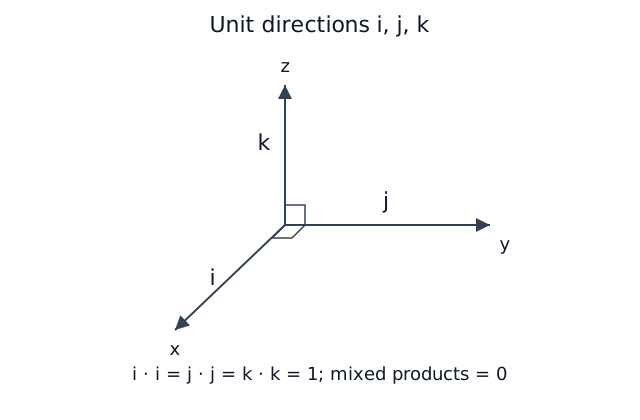
Schematic three-dimensional x,y,z axes carry unit vectors i,j,k respectively. All three pairs are perpendicular in space; self-products are 1 and mixed products 0. The y-direction is correctly labelled j, correcting the duplicated i in the source sketch.
Open original diagram (new tab)
Back to reading