Porisma
Back to reading

Vectors: magnitude, direction and products

Work with Cartesian vectors · Diagrams · Complete reading

Choose another diagram

Position, displacement and translation in two dimensions

Expand diagram

Use the scrollbars or arrow keys to inspect details.
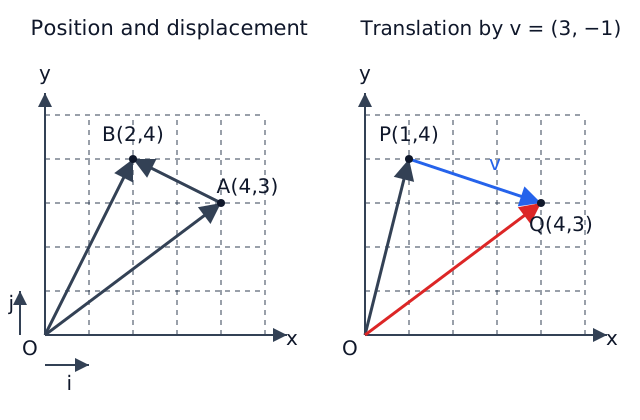
Equal-scale xy grids. Left: A(4,3),B(2,4), position arrows OA, OB and displacement A→B, with unit i,j. Right: P(1,4) maps to Q(4,3) by v=(3,−1); OP+v=OQ.
Open original diagram (new tab)

Three-dimensional coordinate decomposition

Expand diagram

Use the scrollbars or arrow keys to inspect details.
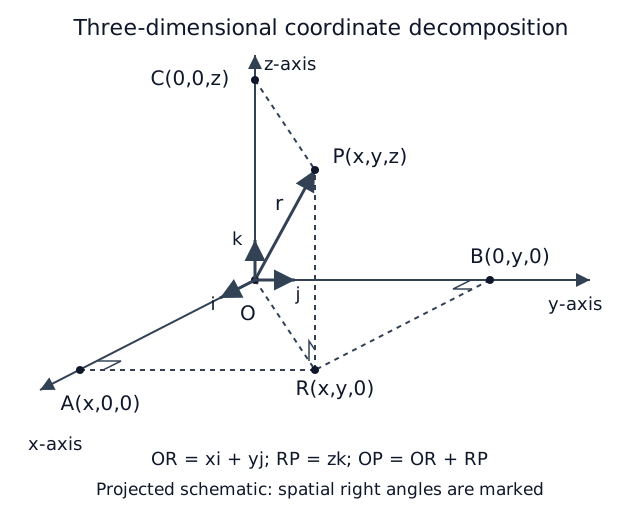
Schematic source projection: A(x,0,0),B(0,y,0),C(0,0,z),R(x,y,0),P(x,y,z), mutually perpendicular coordinate axes and basis i,j,k. Dashed projections and right-angle markers show OR in the xy-plane and RP parallel to z; OP is the resultant.
Open original diagram (new tab)

Right-handed coordinate directions

Expand diagram

Use the scrollbars or arrow keys to inspect details.
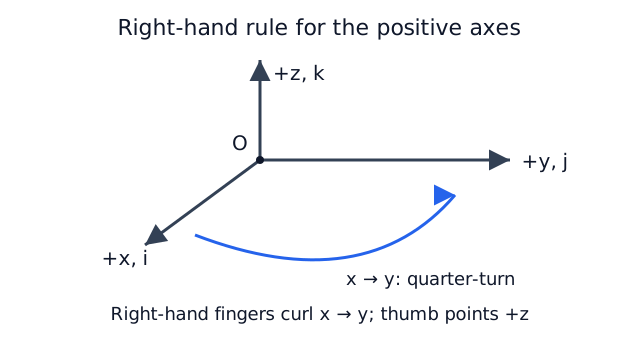
Curl the right-hand fingers from positive x to positive y; the thumb gives positive z. The source hand’s direction role is represented by the labelled turn and +z arrow. Spatial orthogonality does not imply right angles in this projected picture.
Open original diagram (new tab)
Back to reading