Porisma
Back to reading

Vectors: magnitude, direction and products

Read vector types and notation · Diagrams · Complete reading

Choose another diagram

Vector notation, opposites and unit directions

Expand diagram

Use the scrollbars or arrow keys to inspect details.
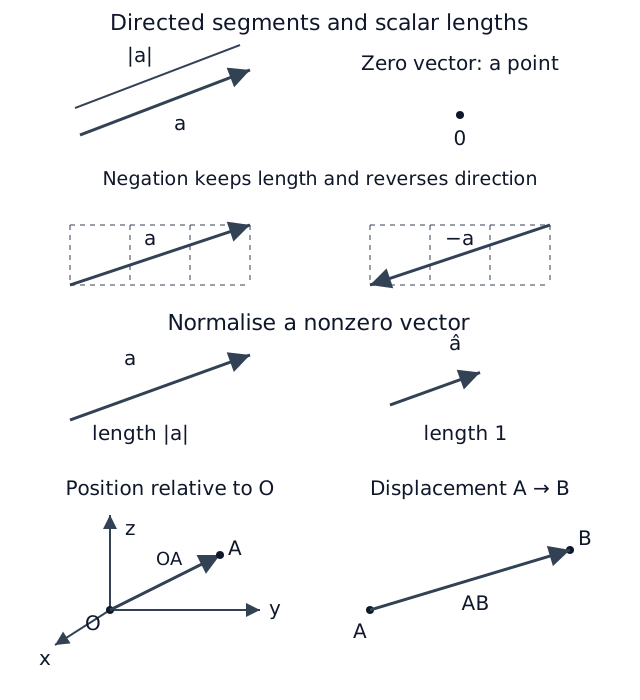
Source roles from pages 2–3: directed a and its scalar length; a and −a on equal grids; a nonzero a and its unit direction; position OA relative to origin and displacement AB between two points. Illustrations are schematic, with no added numerical conditions.
Open original diagram (new tab)

Equal free vectors at different locations

Expand diagram

Use the scrollbars or arrow keys to inspect details.
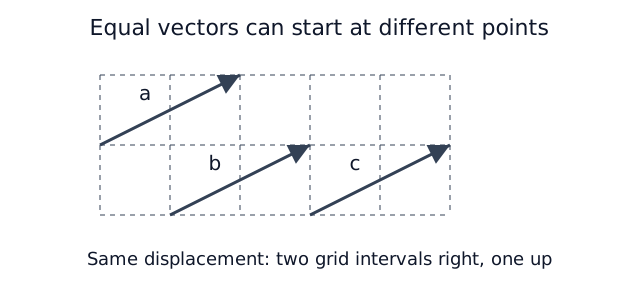
Three arrows a,b,c have identical displacement of two grid intervals right and one up, at different initial points. Their equal lengths and directions make them equal free vectors.
Open original diagram (new tab)
Back to reading