Vectors: planes, normals and distances · Meet a line and a plane
Classify a line and a plane in two checks
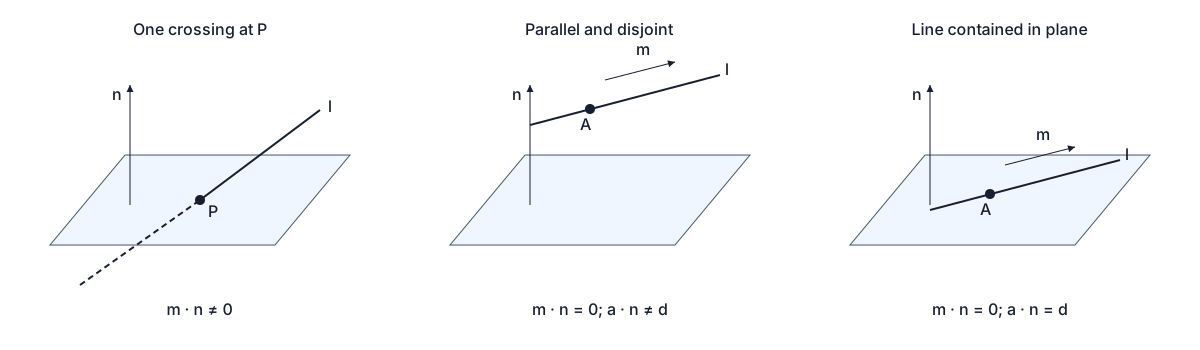
First test the direction. Only a zero direction test needs a point test. The line direction and plane normal must both be nonzero.
Test the line direction
Does the line direction have a nonzero dot product with the plane normal?
- Yes · nonzeroExactly one intersection
When , solve
Substitute this parameter into the line to find the intersection point.
- No · zeroContinue to the point test
When , the line direction is parallel to the plane. This alone does not distinguish containment from a disjoint line.
Never divide by a zero direction test.
Only if zero: test a line point
Use this check only when the direction test is zero. Does the line point lie in the plane?
- Yes · equalThe whole line lies in the plane
: every parameter gives a plane point, so there are infinitely many common points.
- No · unequalParallel and disjoint
: substitution is inconsistent, so there are no common points.
A point on the plane proves containment only after the direction test has returned zero.
Try a worked example
Read a case, make a prediction, then reveal the reasoning. The examples keep their stated values.
Start with this line
Illustration: predict the number of common points.
If the line crosses, must the intersection parameter be positive?
Show reasoning
1. Test the direction
Read a nonzero normal from the plane’s coefficients. The nonzero dot product guarantees exactly one crossing.
2. Find the parameter
Substitute the line into the plane. A line uses every real parameter; a negative value is valid.
3. Check the intersection
Use the parameter in the line, then verify the point in the plane.
Change the direction
Keep the plane and origin. Change only the direction.
Does a zero dot product prove containment?
Show reasoning
1. The direction is now parallel
Read the same normal from the plane. The zero dot product requires a point test. Do not divide by it.
2. Test the base point
The origin is not in this plane. Since the direction is parallel to the plane, no point of the line can enter it.
3. Check the whole line
Substitution gives a contradiction for every parameter: the line and plane are disjoint.
Move the base point
Keep the plane and direction. Change only the base point.
How many common points now?
Show reasoning
1. Reuse the direction test
The plane and direction are unchanged, so the dot product is still zero.
2. Test the new base point
This point is in the plane. Together with the zero direction test, that proves containment.
3. Verify every parameter
The parameters cancel and the plane equation is always satisfied. There are infinitely many common points.
Compare the three geometric cases
Expand diagramFit diagram to page
Use the scrollbars or arrow keys to inspect details.