Vectors: planes, normals and distances
← Back to learning units · Complete chapter reading and print view · Open reference notes separately
By the end, you can
- Describe planes using normals or two directions
- Find point-to-plane distance
- Relate angles and intersections to vector products
about 40 minutes for the lesson · practise at your own pace.
The central idea
A plane can be written , where its nonzero normal vector is perpendicular to every direction in the plane. Equivalently, two independent in-plane directions give a parametric equation. The distance from P is .
Derive a parametric plane
Choose a fixed point A with position a and two nonparallel nonzero directions b,c parallel to the plane. A displacement in the plane is . Triangle addition gives , hence
This equation is not unique: another base point or independent pair of directions can describe the same plane. A drawn parallelogram is only a finite patch of an infinite plane and does not bound the real parameters. Parallel directions would not span a plane.
Coordinate planes and the source room analogy
Expand diagramFit diagram to page
Use the scrollbars or arrow keys to inspect details.
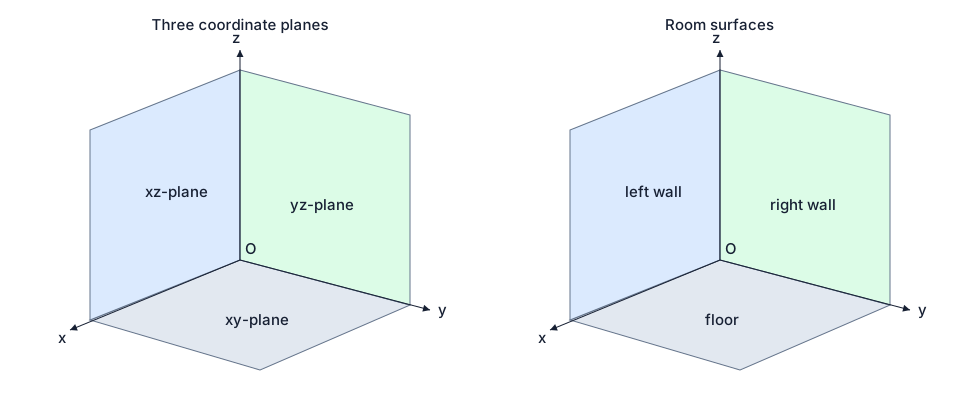
Two directions and one normal
Expand diagramFit diagram to page
Use the scrollbars or arrow keys to inspect details.
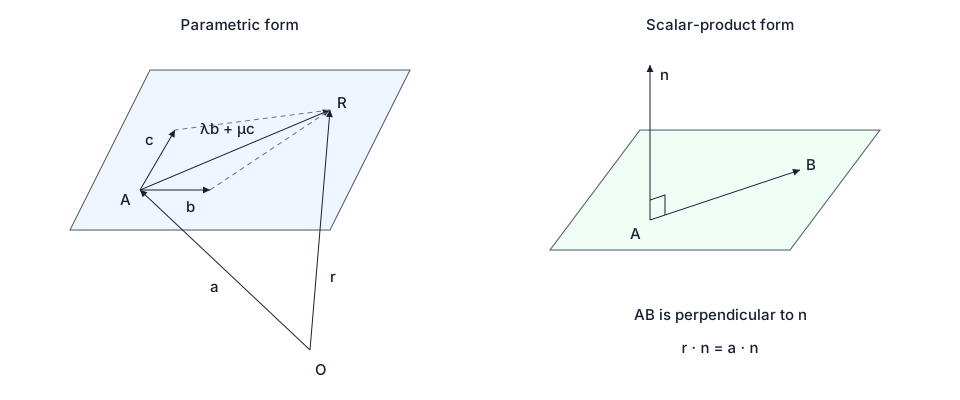
Method map: One plane, three equivalent forms
Convert the same plane between three forms. Compare the methods, then try a worked case.
Parametric → scalar product
Check that the spanning directions are independent. Their cross product must be nonzero.
- Find the normalPerpendicular to both directions
. If the cross product is zero, these directions do not span a plane.
- Fix its positionKeep the matching constant
, so . Scaling requires scaling by the same nonzero factor.
The parameters s and t are independent real numbers. A different point or independent spanning pair can describe the same plane.
Scalar product ↔ Cartesian
Expand a dot product, or read the Cartesian coefficients as a normal.
- ExpandCartesian equation
. The normal’s components are the coefficients of x, y and z.
- RecogniseScalar-product equation
With and , collect the terms as .
If all three coefficients are zero, the equation describes all space when d=0, or no points when d≠0; it is not a plane.
Cartesian → parametric
Solve for a coordinate with a nonzero coefficient and let the other two be free parameters.
- Choose free coordinatesAvoid division by zero
If the coefficient of z is zero, solve for x or y instead. A nonzero normal guarantees at least one valid choice.
- Verify the whole familySame plane, new parameters
Check that the base point satisfies the equation and the two independent directions are perpendicular to the normal. Substitute arbitrary parameters to verify the full family.
Do not expect to recover the original base point and directions. Equivalent parametrizations need not look identical.
Try a worked example
Read a case, make a prediction, then reveal the reasoning. The examples keep their stated values.
Parametric → scalar product
Start with . Which vector is perpendicular to both directions? Predict a scalar-product equation before opening the working.
Show reasoning
1. Find a nonzero normal
Cross the two independent spanning directions. Reversing the order reverses the normal’s sign, which is equally valid.
2. Use a point on the plane
The normal alone does not fix the plane’s position. Use the base point to find the constant.
3. Write scalar-product form
Every displacement within the plane is perpendicular to the normal.
Scalar product → Cartesian
The same plane has . What equation do the coordinates satisfy?
Show reasoning
1. Expand the dot product
Write . The coefficients are the components of the normal, not a point on the plane.
2. Check the original point
Substitute the original base point; keep the constant consistent if the normal is rescaled.
Cartesian → parametric
Return from to a parametric plane. Will it need exactly the same point and directions as the starting equation?
Show reasoning
1. Choose two free coordinates
The coefficient of z is nonzero. Set x=s and y=t, then solve for z. For another plane, solve for a coordinate with a nonzero coefficient.
2. Collect the two directions
The point and directions differ from the original representation, but describe the same plane. Both directions are perpendicular to the original normal.
3. Verify the complete family
Substitute arbitrary s,t, not just one point. The free parameters cancel.
What if the directions are dependent?
Illustration: . Does two-parameter notation guarantee a plane?
Show reasoning
1. Check independence first
The second direction is twice the first, so their cross product is zero. This family traces a line, not a plane; do not use the zero vector as a plane normal.
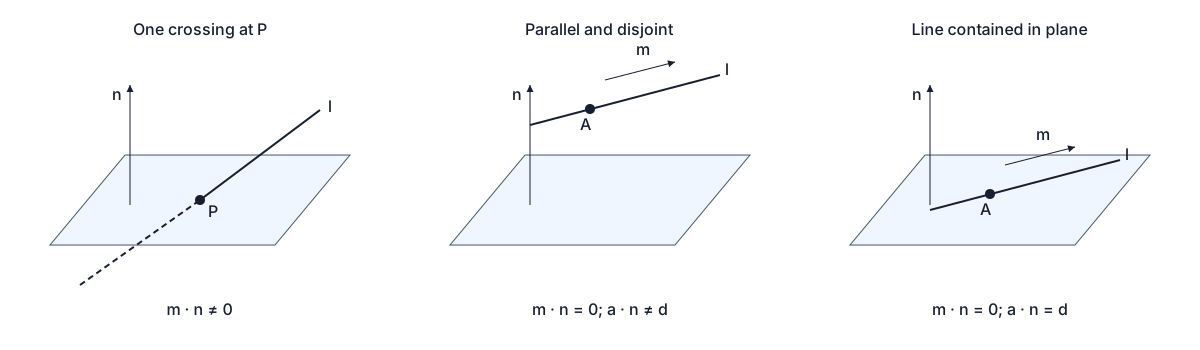
Method map: Classify a line and a plane in two checks
First test the direction. Only a zero direction test needs a point test. The line direction and plane normal must both be nonzero.
Test the line direction
Does the line direction have a nonzero dot product with the plane normal?
- Yes · nonzeroExactly one intersection
When , solve
Substitute this parameter into the line to find the intersection point.
- No · zeroContinue to the point test
When , the line direction is parallel to the plane. This alone does not distinguish containment from a disjoint line.
Never divide by a zero direction test.
Only if zero: test a line point
Use this check only when the direction test is zero. Does the line point lie in the plane?
- Yes · equalThe whole line lies in the plane
: every parameter gives a plane point, so there are infinitely many common points.
- No · unequalParallel and disjoint
: substitution is inconsistent, so there are no common points.
A point on the plane proves containment only after the direction test has returned zero.
Try a worked example
Read a case, make a prediction, then reveal the reasoning. The examples keep their stated values.
Start with this line
Illustration: predict the number of common points.
If the line crosses, must the intersection parameter be positive?
Show reasoning
1. Test the direction
Read a nonzero normal from the plane’s coefficients. The nonzero dot product guarantees exactly one crossing.
2. Find the parameter
Substitute the line into the plane. A line uses every real parameter; a negative value is valid.
3. Check the intersection
Use the parameter in the line, then verify the point in the plane.
Change the direction
Keep the plane and origin. Change only the direction.
Does a zero dot product prove containment?
Show reasoning
1. The direction is now parallel
Read the same normal from the plane. The zero dot product requires a point test. Do not divide by it.
2. Test the base point
The origin is not in this plane. Since the direction is parallel to the plane, no point of the line can enter it.
3. Check the whole line
Substitution gives a contradiction for every parameter: the line and plane are disjoint.
Move the base point
Keep the plane and direction. Change only the base point.
How many common points now?
Show reasoning
1. Reuse the direction test
The plane and direction are unchanged, so the dot product is still zero.
2. Test the new base point
This point is in the plane. Together with the zero direction test, that proves containment.
3. Verify every parameter
The parameters cancel and the plane equation is always satisfied. There are infinitely many common points.
Compare the three geometric cases
Expand diagramFit diagram to page
Use the scrollbars or arrow keys to inspect details.
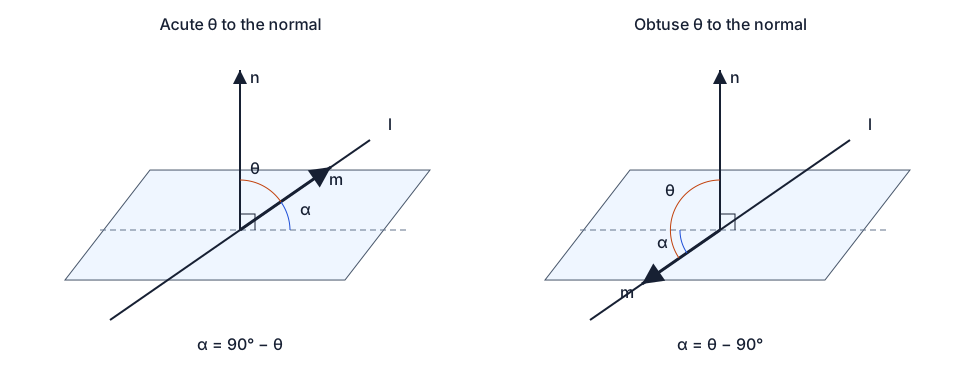
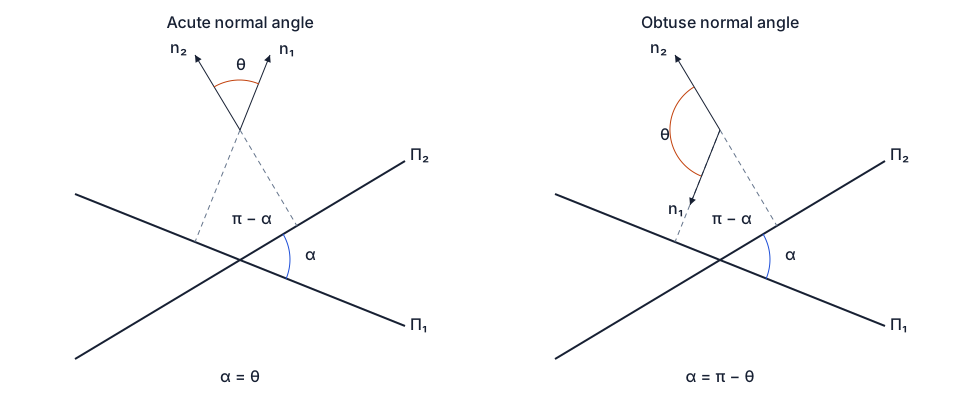
Acute and obtuse angles to the normal
Expand diagramFit diagram to page
Use the scrollbars or arrow keys to inspect details.
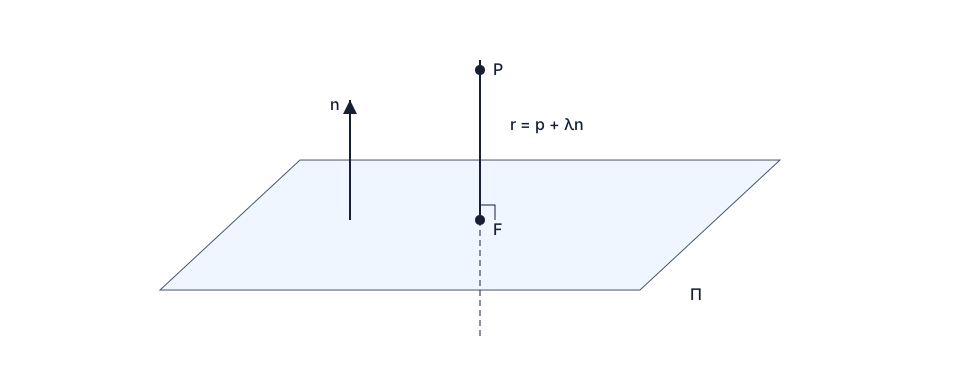
Construct the perpendicular foot
Expand diagramFit diagram to page
Use the scrollbars or arrow keys to inspect details.
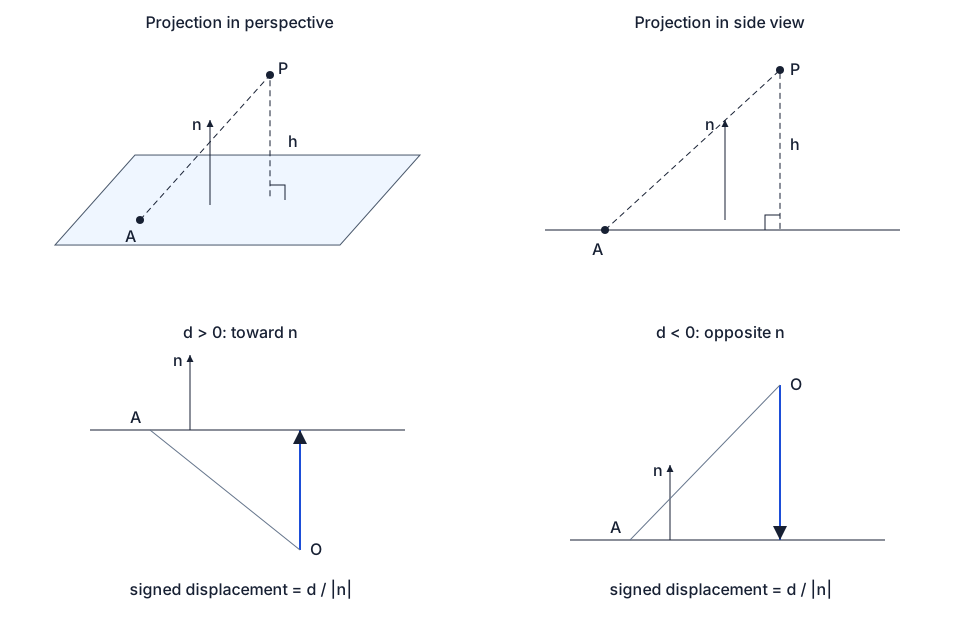
Projection length and signed displacement
Expand diagramFit diagram to page
Use the scrollbars or arrow keys to inspect details.
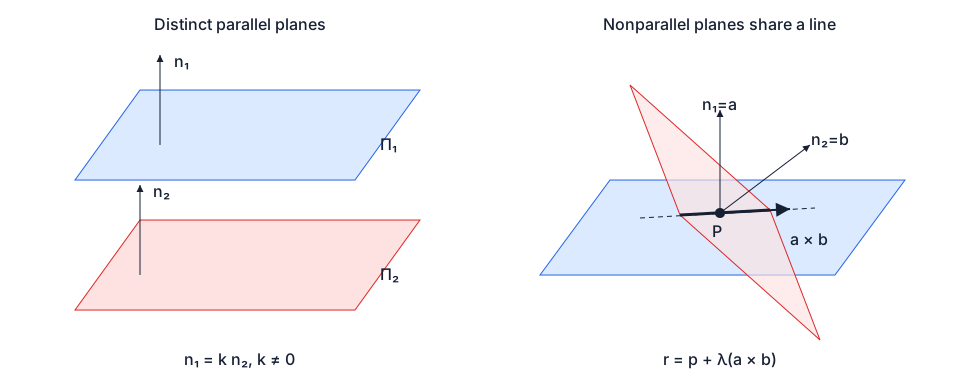
Parallel planes and a common intersection line
Expand diagramFit diagram to page
Use the scrollbars or arrow keys to inspect details.
Plane angles from acute or obtuse normal angles
Expand diagramFit diagram to page
Use the scrollbars or arrow keys to inspect details.
Explore
For the plane , compare lines from the origin with directions and . Use dot products to predict whether each crosses the plane before substituting. Move the base point of the first line to without changing its direction and predict what changes. Explain how a contradiction, an identity and a single parameter solution represent the three geometric outcomes.
Related interactive example
Explore this related example, then return to the prediction task above.
Worked example
The plane has normal with magnitude 3. The origin is distance from the plane. Its perpendicular foot is .
The normal vector is perpendicular to the plane; it is not a direction lying in the plane.
Check your understanding
A point is and a plane is . Find the perpendicular foot F, the distance from P to the plane and the reflection Q of P in the plane. Verify the plane, direction and midpoint conditions. Explain why writing the plane as must give the same results.
A normal is , with and . Put . The plane condition gives , so and . Indeed , and is parallel to the normal. The distance is 3.
The image is , and . With the reversed normal and constant, the parameter becomes and the displacement is still . Scaling both sides preserves the plane, its foot, distance and reflected point; only the chosen normal orientation changes.
Mastery learning objectives
At the end of this chapter, I should be able to:
Choose a practice question
The source common-question map retains its printed Lecture / Discussion / Review numbering, including “Hence”, “verify” and “last part”. A dash represents a blank source cell. Use the practice list to open the incorporated questions; this map records the source references rather than certifying completion of any unreviewed pages.
| Common question type | Lecture examples | Discussion questions | Review problems (follow up) |
|---|---|---|---|
| Equation of a plane: parametric, scalar product, Cartesian | 28, 29, 30, 42(ii) | 1, 3(iii), 8(iv), 9(a) & (b), 10(iv) | 1(iv), 2(ii), 5(ii) & (iv), 6(a)(i) & 6(b)(ii), 7(iii), 9(iii) & (v), 10(iii) & (v), 11(iii)(hence), 12(i), 13(iii) |
| Line–plane relationship: one crossing, no intersection, or contained line | 31, 32, 33, 42(vi) | 2, 3(i), 5(i), 8(ii) & (iii), 9(c), 10(ii) | 4(iii), 5(i), 6(b)(i), 7(ii), 8(i) & (ii), 10(ii), 11(i), 12(ii), 13(i), 14(iii) |
| Angle between a line and a plane | 34 | 2 | 3(ii), 9(i), 11(ii), 14(ii), 15(i) |
| Whether a point lies on a plane | 35 | — | 1(i), 6(a)(i)(verify) |
| Perpendicular foot from a point to a plane | 36 | 4(i), 10(ii) | 1(iii), 2(iv), 3(iii), 5(iii), 6(a)(ii), 9(ii) |
| Perpendicular distance from a point to a plane | 37 | 4(ii) | 3(i), 8(iii), 13(iv) |
| Distance between two parallel planes | 38 | — | 8(iv), 10(iv), 13(iv)(hence) |
| Intersection line of two nonparallel planes | 39, 40 | 6, 7(ii), 8(i) | 1(ii), 4(ii), 7(i), 9(iv) |
| Angle between two planes | 41, 42(iii) | 6, 7(i), 10(iv)(hence) | 4(i) |
| Vectors (Basic): ratio theorem | — | 4(iii) | 3(iii)(hence), 6(a)(ii)(hence), 9(ii)(hence), 13(ii) |
| Vectors (Basic): distance using dot or cross product | — | 3(ii), 7(iii), 10(iii) | 5(iv)(hence), 11(iii), 15(iii) |
| Vectors (Basic): triangle or parallelogram area | — | — | 14(v) |
| Vectors (Lines): vector, Cartesian and parametric line equations | — | 5(ii), 10(i) | 2(iii), 10(i), 12(last part), 15(ii) |
| Vectors (Lines): relationship between two lines | — | — | 2(i), 4(iv), 14(i) |
| Prior topics: transformations | — | — | 8(v) |
Source reference correction: the area row prints Review 14(v), but Review 14 has only (i)–(iv). The triangle-area task is in (iv), following the reflected-ray construction. The table retains the printed reference; use that final part of Question 14.
Practice questions
Practice section 1 · Questions 1–6
Build a parametric plane from lines or points · Use a point and a normal to write a plane · +4 more
Practice section 2 · Questions 7–12
Find the acute angle between a line and a plane · Check a point by substituting into a plane · +4 more
Practice section 3 · Questions 13–18
Use two plane normals and their common base point · Measure the acute angle using two plane normals · +4 more
- Use two plane normals and their common base point
- Measure the acute angle using two plane normals
- Cut a cuboid and check where a perpendicular drill exits
- Three forms of a plane in four settings
- Classify a line relative to a plane before solving
- Use a plane normal to measure distance and construct a perpendicular plane
Practice section 4 · Questions 19–24
Drop a normal from a point and reflect through its foot · Reflect a line using its fixed intersection and one reflected point · +4 more
- Drop a normal from a point and reflect through its foot
- Reflect a line using its fixed intersection and one reflected point
- Find a common line and use normals for the acute plane angle
- Equate absolute normal distances to two intersecting planes
- Separate a unique triple intersection from a common line
- Interpret a plane equation and derive the line-intersection parameter
Practice section 5 · Questions 25–30
Project a pyramid shadow under two different lighting models · Build an intersection line and a perpendicular plane · +4 more
- Project a pyramid shadow under two different lighting models
- Build an intersection line and a perpendicular plane
- Use prism geometry to choose line and plane directions
- Find a line-plane angle and reflect a point
- Separate plane angles, intersections and orthogonal directions
- Construct a plane parallel to a line and measure their separation
Practice section 6 · Questions 31–36
Use normals for parallel planes and lines inside a plane · Recover plane constants from an intersection line · +4 more
- Use normals for parallel planes and lines inside a plane
- Recover plane constants from an intersection line
- Transform a plane after finding intersections and parallel offsets
- Reflect a plane by retaining its intersection and reflecting one point
- Construct a line equidistant from two perpendicular planes
- Use line and plane distances to determine a parallel plane
Practice section 7 · Questions 37–40
Reflect a light ray using the plane normal · Find the locus of a fixed-ratio point between a line and a plane · +2 more
More practice
Use geometry to choose a direction, normal or projection, then verify the resulting point in every required plane. Distinguish a line–plane angle from an angle between normals.
Ready to try this on your own?
For “Vectors: planes, normals and distances”, try a question without the working and explain your method. This records your confidence, saved in this browser only.