Porisma
Back to reading

Vectors: planes, normals and distances

Find perpendicular feet and distances · Diagrams · Complete reading

Choose another diagram

Construct the perpendicular foot

Expand diagram

Use the scrollbars or arrow keys to inspect details.
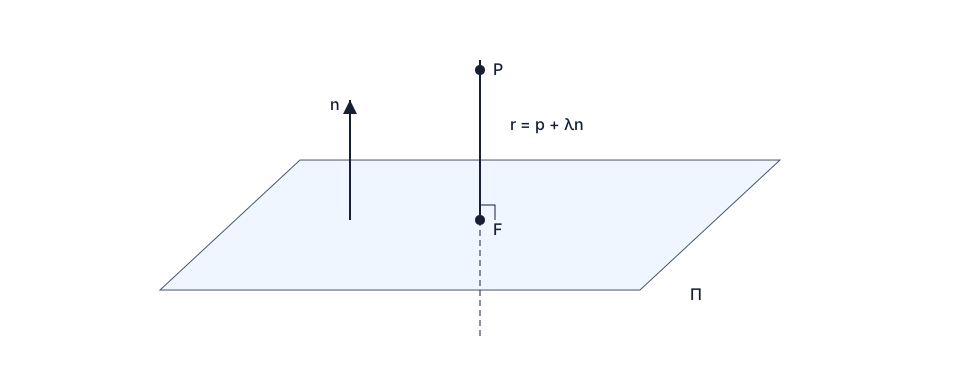
Source schematic: P is off the plane; a line r=p+lambda n through P meets it at the perpendicular foot F. Its direction is parallel to normal n. A dashed continuation passes beyond F, and a right-angle marker shows perpendicularity.
Open original diagram (new tab)

Projection length and signed displacement

Expand diagram

Use the scrollbars or arrow keys to inspect details.
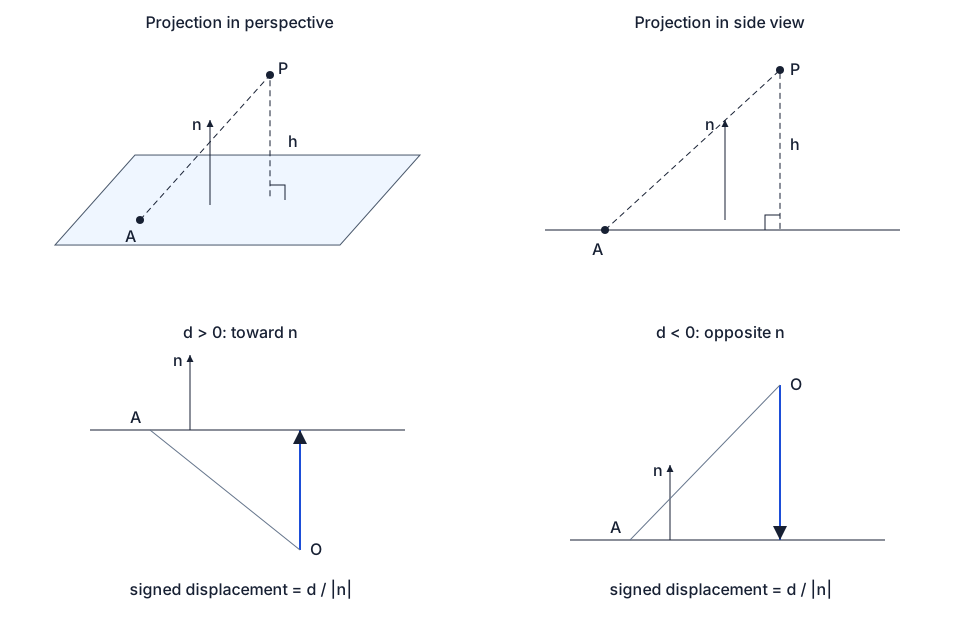
Four source roles: a perspective plane with A in it and P above its perpendicular foot; the same projection as a side view with height h; a positive-d plane reached from origin O along n; a negative-d plane reached opposite n. Distance uses an absolute value, whereas signed displacement is d/|n|.
Open original diagram (new tab)
Back to reading