Worked solution
Read cubic roots and rotate roots of a complex quadratic
Do not use a graphic calculator in answering this question.
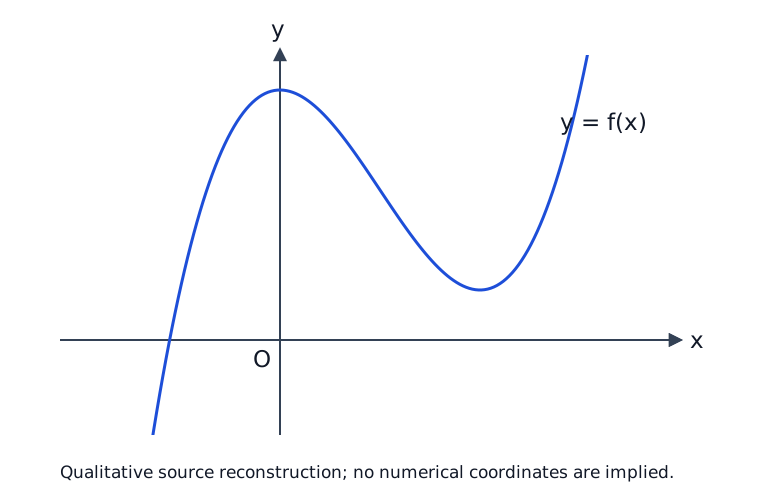
(a) The diagram shows for a cubic polynomial with real coefficients. What can be said about all roots of ? marks
(b) The equation , where is a nonzero real number, has a root . Show that and determine the other root in Cartesian form. Hence find the roots of . marks
Expand diagramFit diagram to page
Use the scrollbars or arrow keys to inspect details.
[2017/DHS/I/8(a),(b)]
CJC · Review problems · Question 8
Answer
(a) One real root and a non-real conjugate pair. (b) ; other z-root ; w-roots .
(a) Interpret the complete sketch
The curve crosses the horizontal axis once, to the left of the vertical axis; both distinct turning points lie strictly above the horizontal axis. Thus there is one real root (negative in this sketch), and the remaining two roots are non-real. Real coefficients force those two roots to form a complex-conjugate pair. The turning-point information rules out confusing this sketch with a triple real root.
(b) Determine c
Substitute : . The real terms cancel and the imaginary coefficient is , so .
(b) Other root: source method 1, factorisation
Write with . Comparing constants gives , so . Therefore the other root solves , giving .
(b) Other root: source method 2, sum of roots
Alternatively let the other root be . The sum is . Thus and , giving , and the same root .
(b) Transform to the w-equation
Put . Then becomes . Multiplying by gives the required equation. Therefore or , so or .
Common mistakes
The conjugate-root theorem applies only to real coefficients. The quadratic in(b) has complex coefficients, so 3−4i is not automatically another root.
Solution notes
Source filename says 2026; printed header says 2025/JC2. Rendered pages determine notation; the original extraction is retained unchanged.
The page image says a∈C; the extraction misreads its complex-number symbol as real. This is an extraction artifact, not a source restriction.