Complex numbers and the Argand plane
Practice section 8 of 9
Questions 43–48 in this collection
Practice questions
Review practice · 1 of 6
Reuse a known square after multiplying by i
Express in the form . Hence or otherwise find the roots of . [4]
[N04/I/12(a)]
CJC · Review problems · Question 6
Solution
Review practice · 2 of 6
Reuse a square root before undoing a scale and translation
A graphic calculator is not to be used in answering this question.
Express in the form . Hence find the roots of . [4]
[2009/MJC/I/7(a)]
CJC · Review problems · Question 7
Solution
Review practice · 3 of 6
Read cubic roots and rotate roots of a complex quadratic
Do not use a graphic calculator in answering this question.
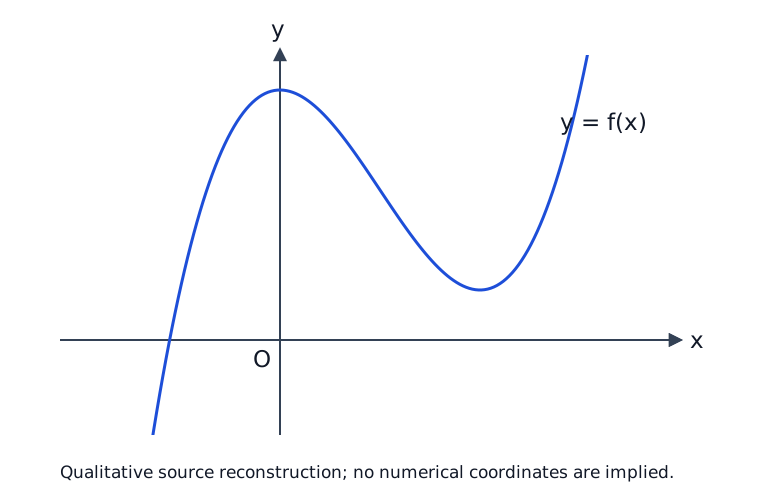
(a) The diagram shows for a cubic polynomial with real coefficients. What can be said about all roots of ? [2]
(b) The equation , where is a nonzero real number, has a root . Show that and determine the other root in Cartesian form. Hence find the roots of . [6]
Expand diagramFit diagram to page
Use the scrollbars or arrow keys to inspect details.
[2017/DHS/I/8(a),(b)]
CJC · Review problems · Question 8
Solution
Review practice · 4 of 6
Distinguish a modulus square from a complex square
(a) The complex numbers satisfy and . Find and . [4]
(b)(i) Given that is a root of , find the second root in Cartesian form, showing your working. [2]
(b)(ii) Hence find the roots of . [2]
[2017/CJC/II/4(a),(b)]
CJC · Review problems · Question 9
Solution
Review practice · 5 of 6
Evaluate a complex quadratic discriminant exactly
Find the roots of , giving answers in Cartesian form where . [2]
[2022/ACJC/II/3(i)]
CJC · Review problems · Question 10
Solution
Review practice · 6 of 6
Solve coupled equations by three algebraic methods
Without the use of a calculator, find the complex numbers satisfying and . [6]
[2017/SAJC/II/1]
CJC · Review problems · Question 11