Porisma

Worked solution

Use horizontal rectangles and the complementary region

The region RR is bounded by the x-axis, y-axis, y=1y=1 and y=ln⁡xy=\ln x, x>0x>0. The diagram approximates its area by AA, the total area of nn rectangles of height 1/n1/n, whose widths use the lower y-endpoint of each strip. Show that

A=1n(1−e1−e1/n).A=\frac1n\left(\frac{1-e}{1-e^{1/n}}\right).

Another finite region SS is bounded by the x-axis, x=ex=e and y=ln⁡xy=\ln x, x>0x>0. Explain how AA approximates the area of SS, and whether this underestimates or overestimates it, giving a reason. Find the exact volume when SS rotates completely about the y-axis.

Expand diagram

Use the scrollbars or arrow keys to inspect details.
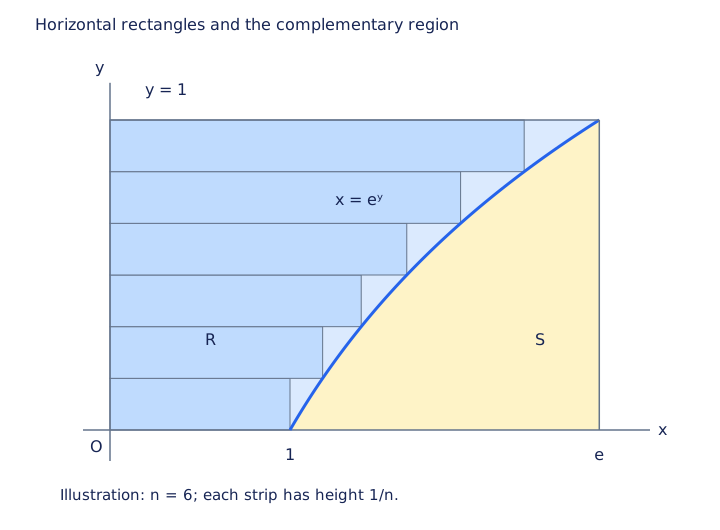
Horizontal rectangles lie inside R, to the left of x=exp(y), between y=0 and y=1. Each uses its lower y-endpoint width. S lies between that curve and x=e, inside the same enclosing rectangle.

[2014/TJC/I/10]

CJC · Review problems · Question 1

Answer

A=1−en(1−e1/n)A=\dfrac{1-e}{n(1-e^{1/n})}; e−Ae-A overestimates SS; V=π2(e2+1)V=\tfrac\pi2(e^2+1).

Read the horizontal widths as a geometric progression

y=ln⁡xy=\ln x gives x=eyx=e^y. The rectangle widths are e0,e1/n,…,e(n−1)/ne^0,e^{1/n},\ldots,e^{(n-1)/n}. Thus A=1n∑r=0n−1er/n=1n[1−(e1/n)n]/(1−e1/n)=1n(1−e)/(1−e1/n)A=\tfrac1n\sum_{r=0}^{n-1}e^{r/n}=\tfrac1n[1-(e^{1/n})^n]/(1-e^{1/n})=\tfrac1n(1-e)/(1-e^{1/n}).

How did this part go?

Subtract from the enclosing rectangle and reverse the error direction

RR and SS partition the rectangle 0≤x≤e0\le x\le e, 0≤y≤10\le y\le1 of area ee. Hence area⁡(S)≈e−A\operatorname{area}(S)\approx e-A. Since eye^y increases, each lower-endpoint horizontal rectangle is inside RR, so A<area⁡(R)A<\operatorname{area}(R) and e−A>area⁡(S)e-A>\operatorname{area}(S): an overestimate.

How did this part go?

Rotate the complement using washers

At height y∈[0,1]y\in[0,1], SS runs from x=eyx=e^y to x=ex=e. Its washer has area π[e2−e2y]\pi[e^2-e^{2y}]. Therefore V=πe2−π∫01e2y dy=πe2−π2(e2−1)=π2(e2+1)V=\pi e^2-\pi\int_0^1e^{2y}\,dy=\pi e^2-\tfrac\pi2(e^2-1)=\tfrac\pi2(e^2+1). This is the enclosing cylinder less the rotated region RR.

How did this part go?

Common mistakes

Subtracting an underestimated area from a fixed total produces an overestimate of the complementary area.

Read the hint