Porisma

A hint to get started

Use horizontal rectangles and the complementary region

The region RR is bounded by the x-axis, y-axis, y=1y=1 and y=ln⁡xy=\ln x, x>0x>0. The diagram approximates its area by AA, the total area of nn rectangles of height 1/n1/n, whose widths use the lower y-endpoint of each strip. Show that

A=1n(1−e1−e1/n).A=\frac1n\left(\frac{1-e}{1-e^{1/n}}\right).

Another finite region SS is bounded by the x-axis, x=ex=e and y=ln⁡xy=\ln x, x>0x>0. Explain how AA approximates the area of SS, and whether this underestimates or overestimates it, giving a reason. Find the exact volume when SS rotates completely about the y-axis.

Expand diagram

Use the scrollbars or arrow keys to inspect details.
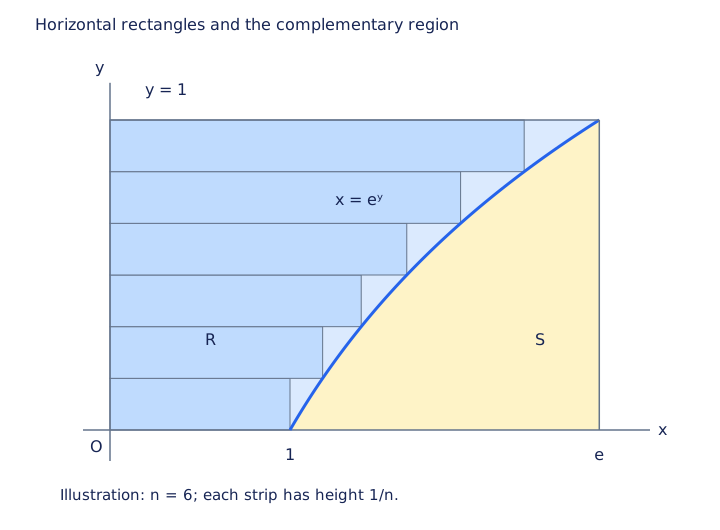
Horizontal rectangles lie inside R, to the left of x=exp(y), between y=0 and y=1. Each uses its lower y-endpoint width. S lies between that curve and x=e, inside the same enclosing rectangle.

[2014/TJC/I/10]

CJC · Review problems · Question 1

Write x as a function of y; the rectangle widths form a geometric progression.

Read the worked solution