Worked solution
Split an absolute integral at the sign change
The curve is , .
(i) Find its exact x-axis intercepts. marks
(ii) Sketch , stating all x- and y-axis intercept coordinates. marks
(iii) Find the exact value of . marks
(iv) Find the volume when the region bounded by , the x-axis and rotates completely about the x-axis. marks
[2014/IJC/I/11]
CJC · Review problems · Question 10
Answer
Intercepts ; absolute integral ; volume cubic units (3 s.f.).
(i) and (ii) Locate all intercepts and the final region
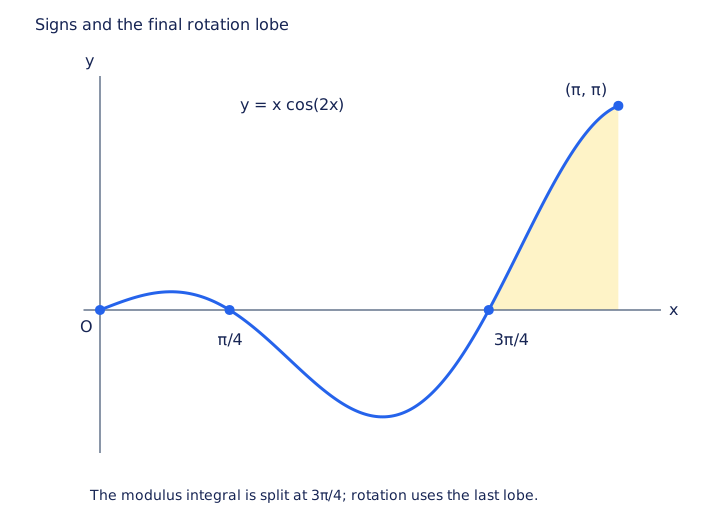
gives . The intercept points are , and , with the origin also the y-intercept. The curve is positive on , negative on and positive on , ending at . The origin is an included domain endpoint, rather than a two-sided crossing.
(iii) Integrate the signed function by parts, then split the modulus
An antiderivative is . Hence . The modulus bars in the rendered question are essential; the native extraction drops them.
(iv) Rotate only the final positive lobe
The stated region adjacent to starts at . Thus cubic units (3 s.f.). The negative lobe from (iii) is not part of this region.
Compare your sketch
Expand diagramFit diagram to page
Use the scrollbars or arrow keys to inspect details.
Common mistakes
The absolute integral includes two lobes, while the volume region bounded by x=pi uses only the last positive lobe.