Worked solution
Transform a square-root exponential volume
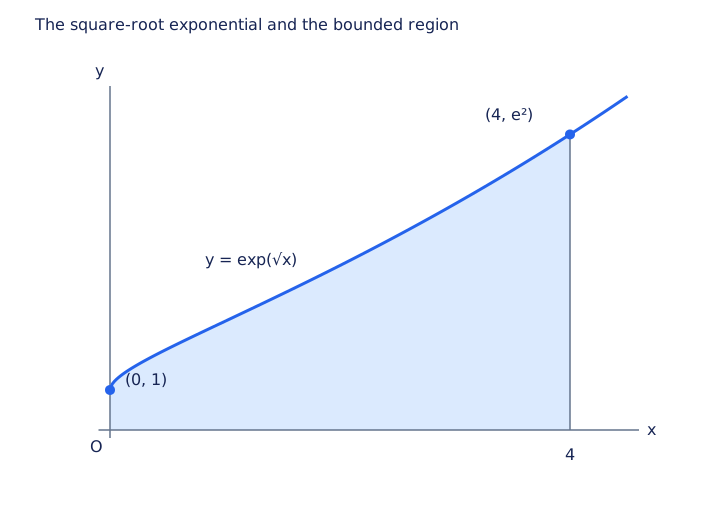
Sketch , . mark Rotate the region bounded by this curve, and both axes completely about the x-axis. Use to show the volume is , and evaluate it exactly. marks
[2014/YJC/II/3(c)]
CJC · Review problems · Question 11
Answer
.
Sketch the increasing curve and the bounded region
The curve begins at , increases, and passes through . It has a vertical one-sided tangent at . Its concavity changes at ; plotting the actual formula retains the early concave-down segment as well as the later rise. The requested region is underneath the curve for .
How did this part go?
Change the radius, differential and limits
. With , , , , this is .
How did this part go?
Evaluate by parts
. Therefore cubic units.
How did this part go?
Compare your sketch
Expand diagramFit diagram to page
Use the scrollbars or arrow keys to inspect details.
Common mistakes
The substitution changes the bounds from 0,4 to 0,2 and introduces the factor 2t.