Worked solution
Sketch a derivative across two vertical asymptotes
The diagram, not to scale, shows the graph of . The vertical asymptotes are and . Sketch the graph of , showing all corresponding coordinates and asymptotes where possible. marks
Expand diagramFit diagram to page
Use the scrollbars or arrow keys to inspect details.
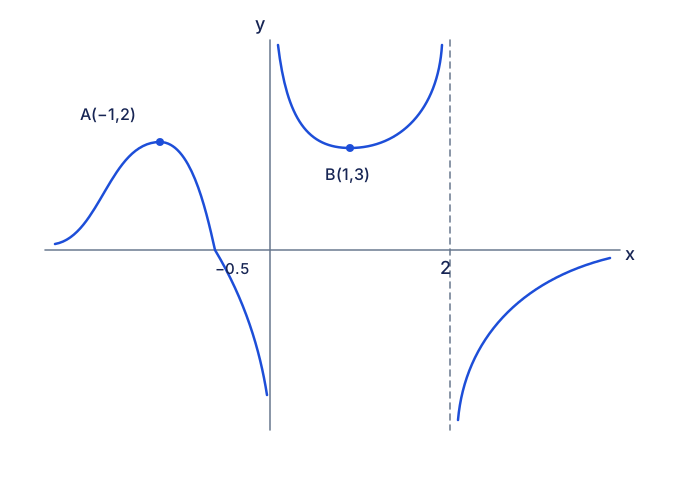
[2010/SRJC/I/6(a)]
CJC · Review problems · Question 1
Answer
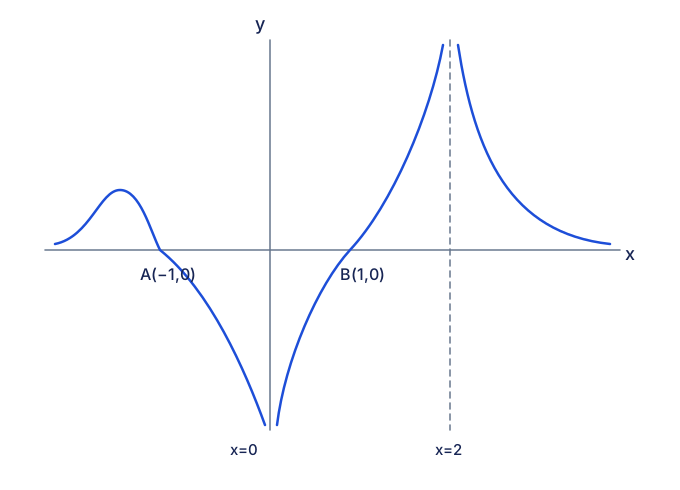
Zeros and ; source answer has asymptotes , with the branches shown.
Translate stationary points into zeros
The source curve has a local maximum and local minimum . Its derivative crosses the axis at from positive to negative and at from negative to positive. The original zero does not specify a derivative zero.
Retain the source asymptotic branches
The supplied answer sketch has vertical asymptotes and : its slopes tend to negative infinity on both sides of 0 and positive infinity on both sides of 2. Its outer derivative branches approach the x-axis. The three branches in the reconstructed answer retain those behaviours and both labelled zeros.
Read what is and is not determined
The derivative is positive for , negative for and , and positive for and , following the pictured rises and falls. These are the qualitative features requested by the source sketch, not a uniquely determined formula. A vertical asymptote of a general function alone does not prove a derivative asymptote; here the branch shape is also part of the supplied schematic.
Compare your sketch
Expand diagramFit diagram to page
Use the scrollbars or arrow keys to inspect details.
Common mistakes
The original graph’s y-coordinates 2 and 3 become zero slopes, not derivative y-values.
Solution notes
Both source prompt and answer figures independently reconstructed. No unique derivative formula or extra turning-point coordinates are invented. Source asymptotic slope behaviour is qualified as information in the supplied schematic.