Review practice · Section 1 of 2
Questions 1–6 in this collection
Sketch a derivative across two vertical asymptotes · Sketch the gradient across a pole and a minimum · +4 more
- 1
The diagram, not to scale, shows the graph of . The vertical asymptotes are and . Sketch the graph of , showing all corresponding coordinates and asymptotes where possible. marks
Expand diagramFit diagram to page
Use the scrollbars or arrow keys to inspect details.
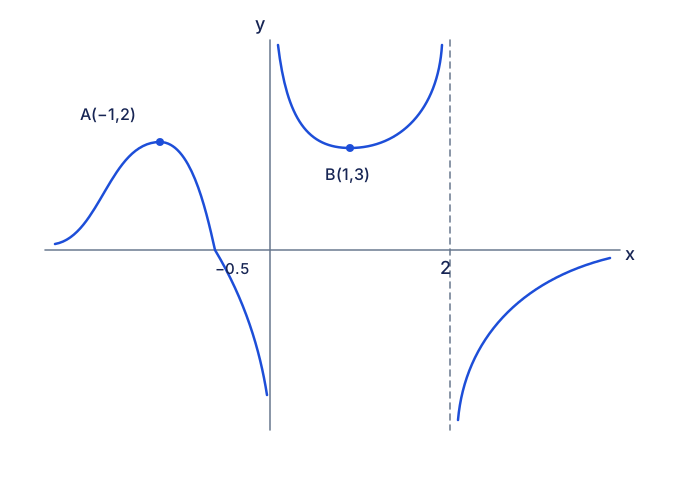
Qualitative graph, not to scale: local maximum A(-1,2) on the negative-x branch, zero at -0.5, vertical asymptote x=0; between 0 and 2 a U-shaped branch has minimum B(1,3); beyond x=2 the curve rises from negative infinity towards the x-axis. No numerical function is supplied. [2010/SRJC/I/6(a)]
CJC · Review problems · Question 1
- 2
The graph of has asymptotes , and minimum , as shown. Sketch , clearly indicating any asymptotes, turning points and axial intercepts. marks
The supplied graph also labels x-intercepts and y-intercept .
Expand diagramFit diagram to page
Use the scrollbars or arrow keys to inspect details.
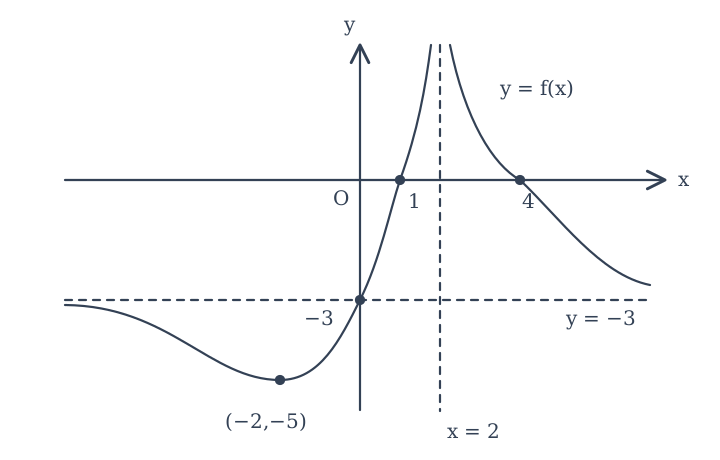
Given function with vertical asymptote x=2 and horizontal asymptote y=−3. The left branch initially falls below −3, reaches minimum (−2,−5), then rises through (0,−3) and (1,0) to positive infinity at 2 from the left. The right branch falls from positive infinity at 2 from the right, crosses (4,0), then tends to −3 from above. [2009/CJC/Promo/10(c)]
CJC · Review problems · Question 2
- 3
The diagram shows with a maximum at , minimum at , and stationary point of inflection at the origin. On a separate diagram draw . marks
Expand diagramFit diagram to page
Use the scrollbars or arrow keys to inspect details.
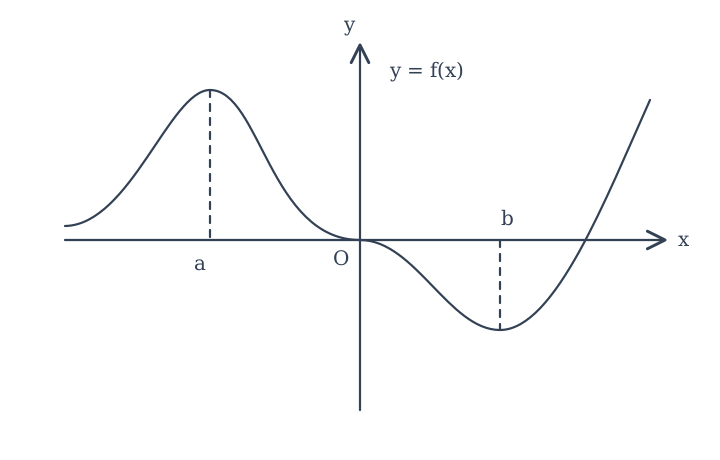
Given function rises to a maximum at negative x=a, decreases through a stationary inflection at the origin, continues to a minimum at positive x=b, then rises. The two turning-point x-values are marked a and b without numerical coordinates. [2009/SRJC/Promo/2]
CJC · Review problems · Question 3
- 4
The diagram shows with asymptotes and , y-intercept , minimum and maximum .
Sketch the curve . marks
Expand diagramFit diagram to page
Use the scrollbars or arrow keys to inspect details.
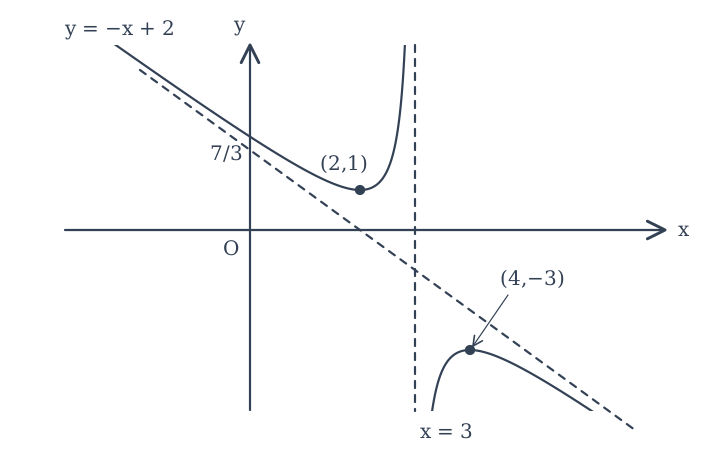
Given function with asymptotes x=3 and y=−x +2, y-intercept 7/3, minimum (2,1) on the left branch and maximum (4,−3) on the right. The left branch tends up without bound at 3 from the left; the right starts at negative infinity and rises to its maximum before falling. [2010/VJC/Promo/6(ii)]
CJC · Review problems · Question 4
- 5
The diagram shows meeting the x-axis at and . Given and :
(i) State the coordinates and natures of the stationary points of . marks
(ii) Find the range of for which the curve is strictly decreasing. marks
(iii) Sketch . marks
Expand diagramFit diagram to page
Use the scrollbars or arrow keys to inspect details.
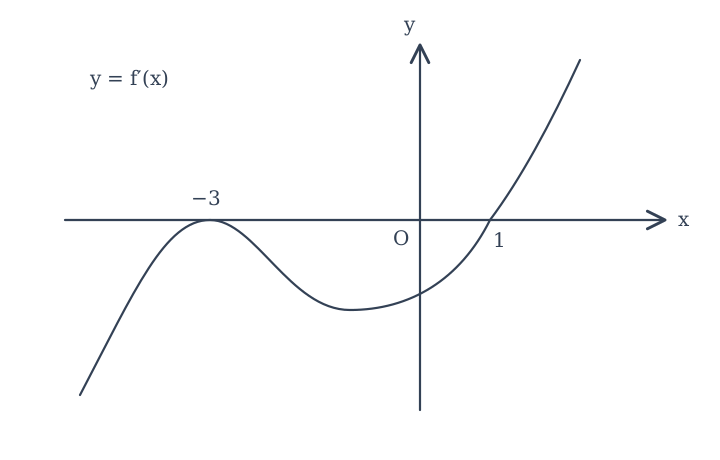
Given derivative is negative before −3, touches zero at −3 as a local maximum, falls to an unlabelled negative minimum, then rises and crosses the axis at 1. It is positive after 1. [2010/TPJC/I/6]
CJC · Review problems · Question 5
- 6
The curve is , where are constants, and is an asymptote.
(i) Show that , . marks
(ii) Given , sketch , showing all asymptotes, stationary points and axial intercepts, if any. marks
(iii) Sketch , showing all asymptotes, axial intercepts and stationary points, if any. marks
[2010/TPJC/Promo/10(i),(ii),(iii)(a)]
CJC · Review problems · Question 6