Porisma

A hint to get started

Differentiate turning points and a stationary inflection

The diagram shows y=f(x)y=f(x) with a maximum at x=ax=a, minimum at x=bx=b, and stationary point of inflection at the origin. On a separate diagram draw y=f′(x)y=f^{\prime}(x). marks

Expand diagram

Use the scrollbars or arrow keys to inspect details.
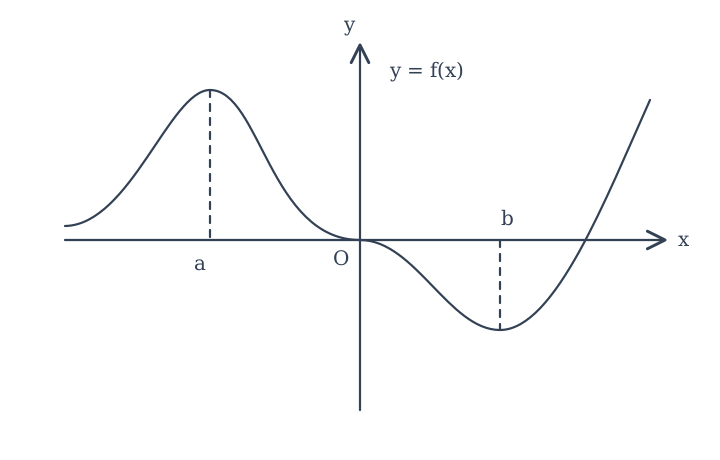
Given function rises to a maximum at negative x=a, decreases through a stationary inflection at the origin, continues to a minimum at positive x=b, then rises. The two turning-point x-values are marked a and b without numerical coordinates.

[2009/SRJC/Promo/2]

CJC · Review problems · Question 3

A stationary inflection has a zero gradient without a reversal of the function’s direction.

Read the worked solution