Porisma

A hint to get started

Read a derivative from an oblique asymptote and two extrema

The diagram shows y=f(x)y=f(x) with asymptotes x=3x=3 and y=−x+2y=-x+2, y-intercept 7/37/3, minimum (2,1)(2,1) and maximum (4,−3)(4,-3).

Sketch the curve y=f′(x)y=f^{\prime}(x). marks

Expand diagram

Use the scrollbars or arrow keys to inspect details.
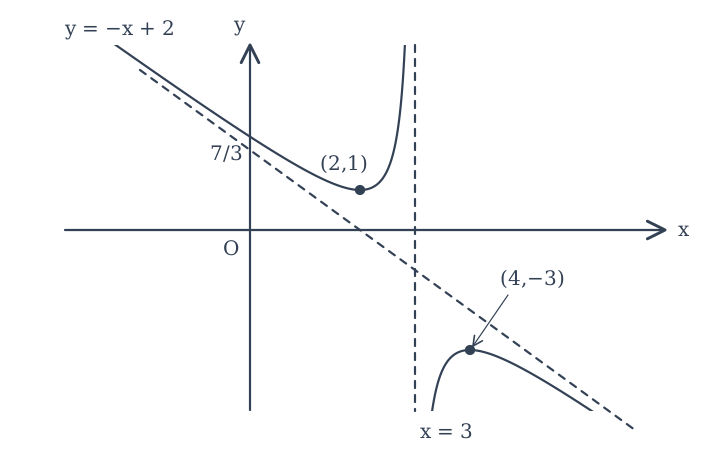
Given function with asymptotes x=3 and y=−x+2, y-intercept 7/3, minimum (2,1) on the left branch and maximum (4,−3) on the right. The left branch tends up without bound at 3 from the left; the right starts at negative infinity and rises to its maximum before falling.

[2010/VJC/Promo/6(ii)]

CJC · Review problems · Question 4

The oblique asymptote has gradient −1; combine that source shape with the extrema at 2 and 4.

Read the worked solution