Porisma

Worked solution

Determine a rational curve and sketch its derivative exactly

The curve CC is y=f(x)=ax2+bx+cy=f(x)=\dfrac{ax^2+b}{x+c}, where a,b,ca,b,c are constants, and y=−x+2y=-x+2 is an asymptote.

(i) Show that a=−1a=-1, c=2c=2. marks

(ii) Given b=1b=1, sketch CC, showing all asymptotes, stationary points and axial intercepts, if any. marks

(iii) Sketch y=f′(x)y=f^{\prime}(x), showing all asymptotes, axial intercepts and stationary points, if any. marks

[2010/TPJC/Promo/10(i),(ii),(iii)(a)]

CJC · Review problems · Question 6

Answer

a=−1,c=2a=-1,c=2; f=(1−x2)/(x+2)f=(1-x^2)/(x+2) with stationary coordinates (−2±3,4∓23)(-2\pm\sqrt3,4\mp2\sqrt3); f′=−1+3/(x+2)2f^{\prime}=-1+3/(x+2)^2, with no stationary points.

(i) Compare the quotient and oblique asymptote

Polynomial division gives f(x)=ax−ac+(b+ac2)/(x+c)f(x)=ax-ac+(b+ac^2)/(x+c). Its oblique asymptote is y=ax−acy=ax-ac. Comparing with y=−x+2y=-x+2 gives a=−1a=-1 and −ac=2-ac=2, hence c=2c=2.

How did this part go?

(ii) Locate the exact features of C

Now f(x)=(1−x2)/(x+2)=−x+2−3/(x+2)f(x)=(1-x^2)/(x+2)=-x+2-3/(x+2), with asymptotes x=−2x=-2 and y=−x+2y=-x+2. The intercepts are (−1,0),(1,0),(0,1/2)(-1,0),(1,0),(0,1/2).

f′(x)=−1+3(x+2)2,f′=0  ⟺  x=−2±3.f^{\prime}(x)=-1+\frac3{(x+2)^2},\qquad f^{\prime}=0\iff x=-2\pm\sqrt3.

The left stationary point (−2−3,4+23)(-2-\sqrt3,4+2\sqrt3) is a minimum; the right (−2+3,4−23)(-2+\sqrt3,4-2\sqrt3) is a maximum. The source labels these approximately (−3.73,7.46)(-3.73,7.46) and (−0.267,0.536)(-0.267,0.536). The latter x-value is a rounding error: −2+3≈−0.267949-2+\sqrt3\approx-0.267949, which rounds to −0.268-0.268 at three decimal places. The exact coordinates above govern the reconstruction.

How did this part go?

(iii) Sketch the exact gradient function

f′(x)=−1+3/(x+2)2f^{\prime}(x)=-1+3/(x+2)^2 has vertical asymptote x=−2x=-2, horizontal asymptote y=−1y=-1, x-intercepts (−2±3,0)(-2\pm\sqrt3,0) and y-intercept (0,−1/4)(0,-1/4). Since f′′(x)=−6/(x+2)3f^{\prime\prime}(x)=-6/(x+2)^3 never vanishes in the domain, f′f^{\prime} has no stationary points. Its left branch increases from −1-1 towards +∞+\infty, while its right branch decreases from +∞+\infty towards −1-1.

How did this part go?

Compare your sketch

Expand diagram

Use the scrollbars or arrow keys to inspect details.
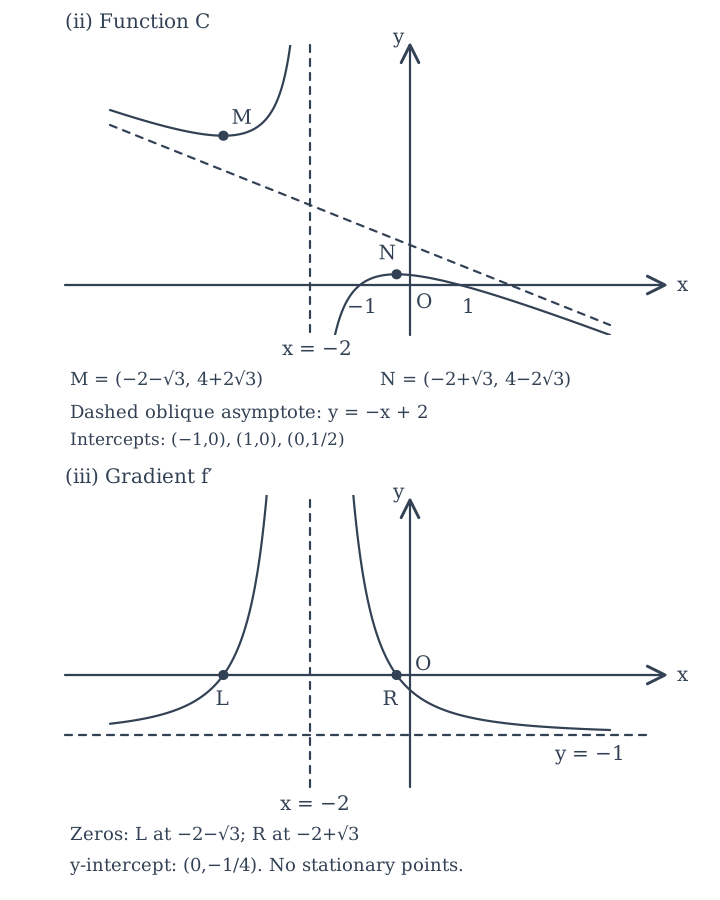
Two exact plots. Function f=(1−x²)/(x+2): asymptotes x=−2 and y=−x+2; intercepts x=−1,1 and y=1/2; minimum (−2−√3,4+2√3), maximum (−2+√3,4−2√3). Derivative f′=−1+3/(x+2)²: asymptotes x=−2,y=−1; zeros −2±√3, y-intercept −1/4; increasing left branch, decreasing right branch, no stationary points.

Common mistakes

The printed −0.267 truncates the stationary x-value; use the exact radical or correctly rounded −0.268.

Read the hint