Applications of differentiation
Practice section 7 of 8
Questions 37–42 in this collection
Practice questions
Review practice · 1 of 6
Reconstruct a decreasing function with an isolated zero gradient
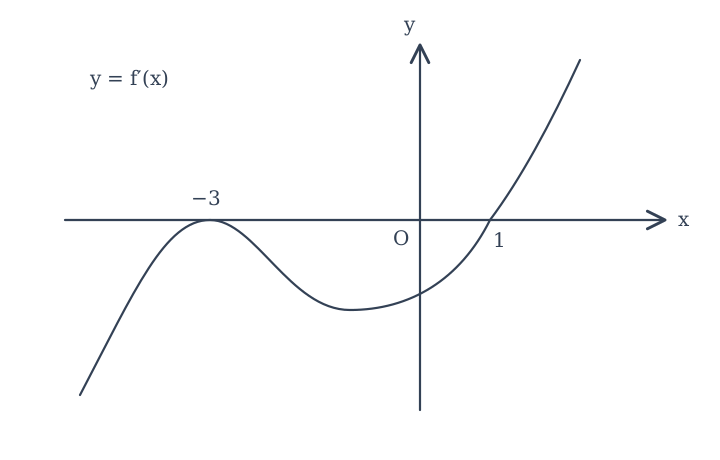
The diagram shows meeting the x-axis at and . Given and :
(i) State the coordinates and natures of the stationary points of . [3]
(ii) Find the range of for which the curve is strictly decreasing. [2]
(iii) Sketch . [2]
Expand diagramFit diagram to page
Use the scrollbars or arrow keys to inspect details.
[2010/TPJC/I/6]
CJC · Review problems · Question 5
Solution
Review practice · 2 of 6
Determine a rational curve and sketch its derivative exactly
The curve is , where are constants, and is an asymptote.
(i) Show that , . [2]
(ii) Given , sketch , showing all asymptotes, stationary points and axial intercepts, if any. [4]
(iii) Sketch , showing all asymptotes, axial intercepts and stationary points, if any. [3]
[2010/TPJC/Promo/10(i),(ii),(iii)(a)]
CJC · Review problems · Question 6
Solution
Review practice · 3 of 6
Identify the parabola touched by every line in a family
The line is tangent to the parabola for every . Find and the coordinates of contact in terms of . [4]
[2014/VJC/I/1]
CJC · Review problems · Question 7
Solution
Review practice · 4 of 6
Convert units before differentiating a conical pile
Sand from a chute forms a conical pile whose altitude is always of its base radius.
(i) How fast is its volume increasing when the radius is m and increases at ? [4]
(ii) How fast is its radius increasing when it is m and the volume increases at ? [3]
CJC · Review problems · Question 8
Solution
Review practice · 5 of 6
Optimise and differentiate a triangle on an implicit curve
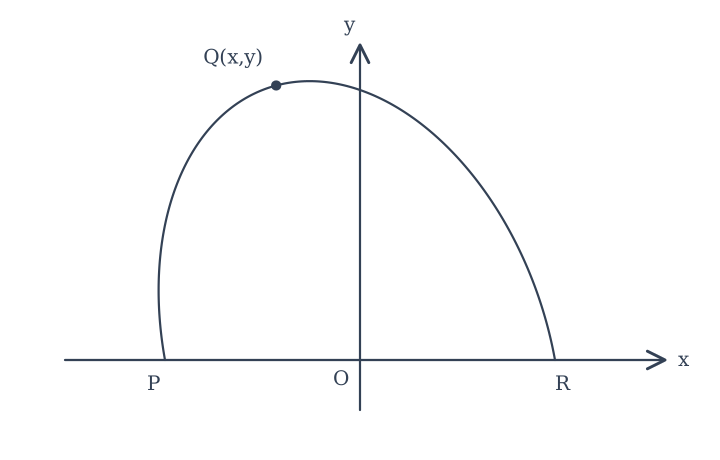
Point lies on , with . The curve meets the x-axis at as drawn.
(i) Show that triangle has area . [3]
(ii) Find in terms of . [2]
(iii) Hence find the x-value where is stationary and use the second derivative test to determine its nature. [6]
If increases at units/s, find the rate of change of when . [3]
Expand diagramFit diagram to page
Use the scrollbars or arrow keys to inspect details.
[2013/DHS/I/11]
CJC · Review problems · Question 9
Solution
Review practice · 6 of 6
Optimise a flower-bed under a wall-building time budget
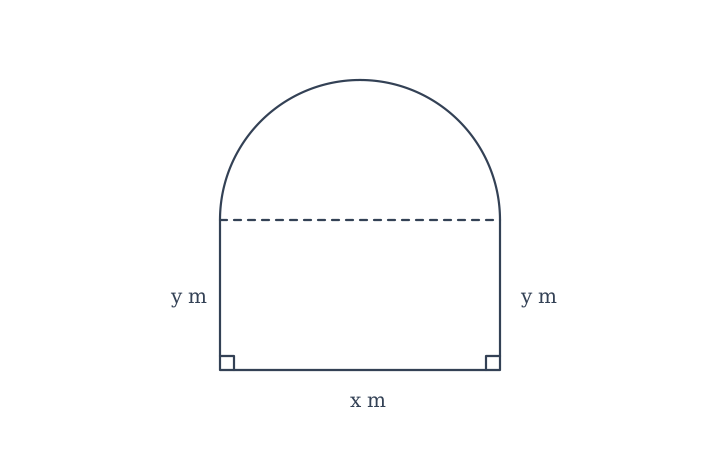
A flower-bed for a large garden consists of an m by m rectangle topped by a semicircle of diameter m. A low wall takes hours per metre along the straight parts and hours per metre around the semicircular arc. A total of hours is available.
Use differentiation to find giving maximum area. [10]
Expand diagramFit diagram to page
Use the scrollbars or arrow keys to inspect details.
[2008/I/7]
CJC · Review problems · Question 10