Porisma

Worked solution

Convert units before differentiating a conical pile

Sand from a chute forms a conical pile whose altitude is always 4/34/3 of its base radius.

(i) How fast is its volume increasing when the radius is 11 m and increases at 1/8 cm s−11/8\text{ cm s}^{-1}? marks

(ii) How fast is its radius increasing when it is 22 m and the volume increases at 1000 cm3 s−11000\text{ cm}^3\text{ s}^{-1}? marks

CJC · Review problems · Question 8

Answer

(i) 5000π/3 cm3 s−15000\pi/3\text{ cm}^3\text{ s}^{-1}. (ii) 3/(160π) cm s−13/(160\pi)\text{ cm s}^{-1}.

Express volume in one changing variable

h=4r/3h=4r/3, so V=13πr2h=49πr3V=\tfrac13\pi r^2h=\tfrac49\pi r^3 and dV/dr=43πr2dV/dr=\tfrac43\pi r^2. Work in centimetres to match the given rates.

How did this part go?

(i) Use r = 100 cm

dV/dt=(dV/dr)(dr/dt)=43πr2(1/8)=πr2/6dV/dt=(dV/dr)(dr/dt)=\tfrac43\pi r^2(1/8)=\pi r^2/6. At r=100r=100 cm, this is 5000π/3 cm3 s−15000\pi/3\text{ cm}^3\text{ s}^{-1}.

How did this part go?

(ii) Use r = 200 cm

1000=43πr2(dr/dt)1000=\tfrac43\pi r^2(dr/dt) gives dr/dt=750/(πr2)dr/dt=750/(\pi r^2). At r=200r=200 cm, the increasing radius has rate 3/(160π) cm s−13/(160\pi)\text{ cm s}^{-1}.

How did this part go?

Compare your sketch

Expand diagram

Use the scrollbars or arrow keys to inspect details.
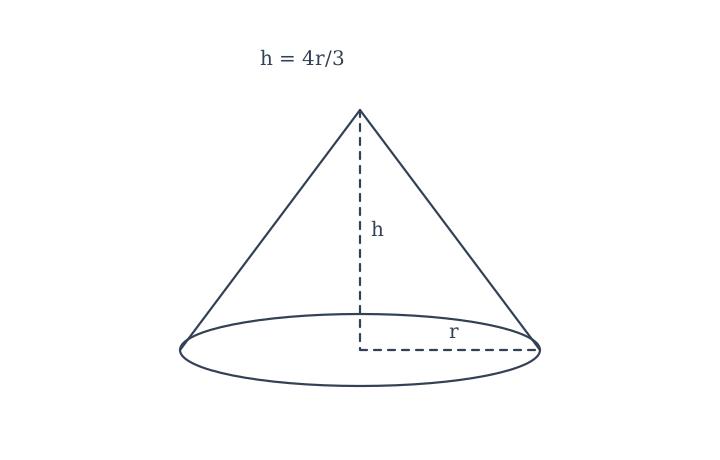
Conical sand pile with base radius r, vertical altitude h and the fixed relation h=4r/3. A central vertical height and horizontal base radius are marked.

Common mistakes

A centimetre rate paired with a metre radius silently changes the units of the result.

Read the hint