Review practice · Section 2 of 2
Questions 7–12 in this collection
Identify the parabola touched by every line in a family · Convert units before differentiating a conical pile · +4 more
- 7
The line is tangent to the parabola for every . Find and the coordinates of contact in terms of . marks
[2014/VJC/I/1]
CJC · Review problems · Question 7
- 8
Sand from a chute forms a conical pile whose altitude is always of its base radius.
(i) How fast is its volume increasing when the radius is m and increases at ? marks
(ii) How fast is its radius increasing when it is m and the volume increases at ? marks
CJC · Review problems · Question 8
- 9
Point lies on , with . The curve meets the x-axis at as drawn.
(i) Show that triangle has area . marks
(ii) Find in terms of . marks
(iii) Hence find the x-value where is stationary and use the second derivative test to determine its nature. marks
If increases at units/s, find the rate of change of when . marks
Expand diagramFit diagram to page
Use the scrollbars or arrow keys to inspect details.
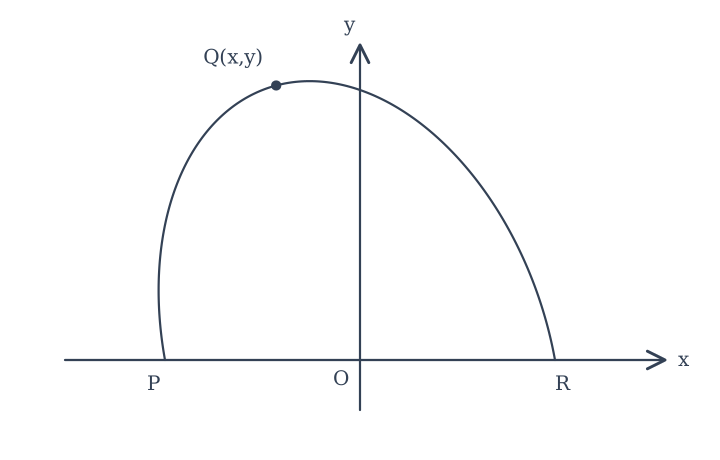
Upper part, y≥0, of the closed curve 4x² +xy +y²=36, with x-axis intersections P and R and a general point Q(x,y) on the upper-left arc. No numerical intercepts are supplied in this given diagram. [2013/DHS/I/11]
CJC · Review problems · Question 9
- 10
A flower-bed for a large garden consists of an m by m rectangle topped by a semicircle of diameter m. A low wall takes hours per metre along the straight parts and hours per metre around the semicircular arc. A total of hours is available.
Use differentiation to find giving maximum area. marks
Expand diagramFit diagram to page
Use the scrollbars or arrow keys to inspect details.
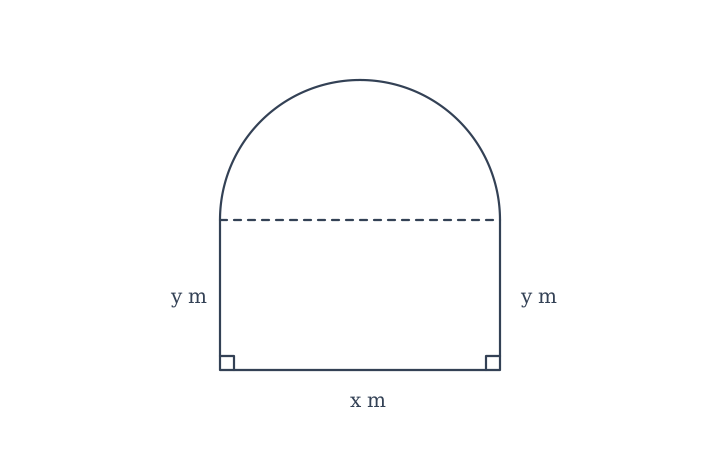
Flower-bed made of a rectangle of width x and height y with a semicircle of diameter x on top. Only the bottom x, two sides y, and outer semicircular arc form the wall; the joining diameter is dashed and internal. [2008/I/7]
CJC · Review problems · Question 10
- 11
A decorative monument for the 2010 Youth Olympic Games consists of a complete globe on a closed cylindrical base of radius and height . The globe radius is . To minimise cost, the total surface area is fixed at .
(i) Show that . marks
Hence find exactly:
(ii) the cylinder radius giving greatest total volume. marks
(iii) that maximum volume. marks
A sphere of radius has area and volume .
Expand diagramFit diagram to page
Use the scrollbars or arrow keys to inspect details.
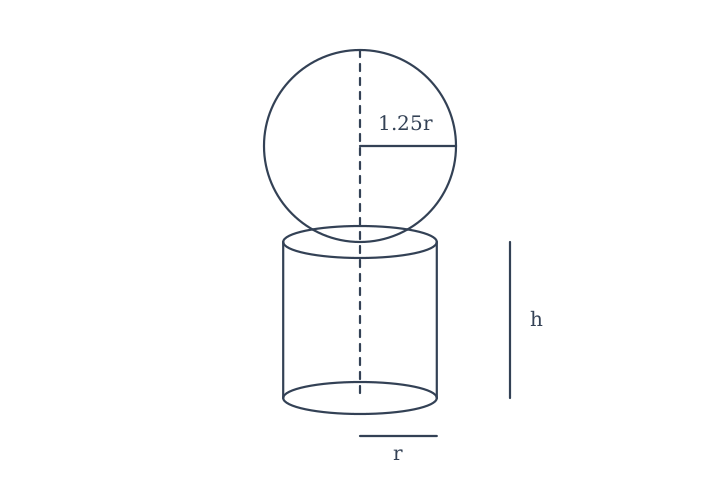
Complete globe above a closed cylindrical base. The globe radius is 1.25r, cylinder radius r and height h. The base has both circular ends; the diagram indicates the full sphere, not a hemisphere. [2009/CJC/Promo/12]
CJC · Review problems · Question 11
- 12
A square lawn has side m and a circular pond of radius m centred at its centre . A rectangular flower crate has corner at the square corner and opposite corner on the pond. Let be the midpoint of on the downward centre line. The angle is measured from , with . Its base area is .
(i) Express in terms of and show . marks
(ii) For stationary values, show the angles satisfy and , where are exact constants. Find . marks
(iii) Classify both stationary values and find their areas. marks
(iv) Four identical crates are placed at , with the rest outside the pond covered by grass. Find the smallest grass area to three significant figures. marks
Expand diagramFit diagram to page
Use the scrollbars or arrow keys to inspect details.
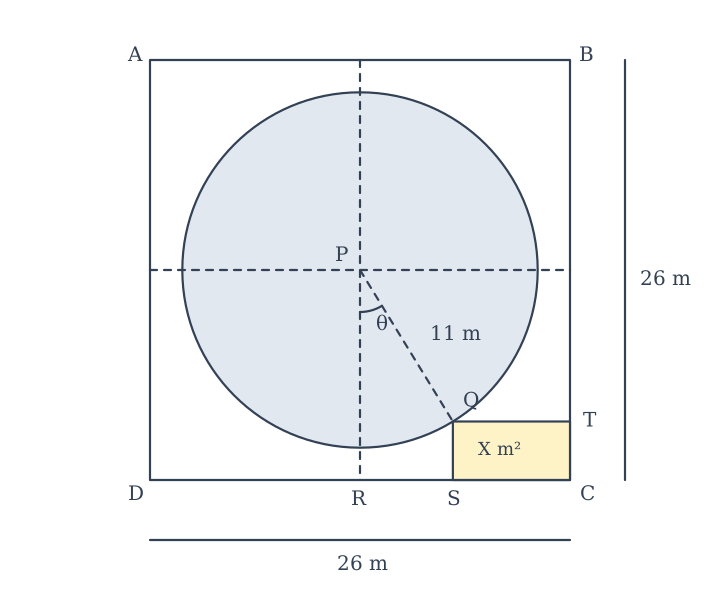
Square ABCD of side 26 m with central circular pond of radius 11 m and centre P. R is the midpoint of bottom side DC. Q lies on the southeast arc, with angle RPQ=theta between downward PR and PQ. Rectangle QTCS occupies the bottom-right corner: T is on BC, S on DC and C is the square corner. Its area is X square metres. The angle is between zero and pi/4. [2022/SAJC/I/10]
CJC · Review problems · Question 12