Worked solution
Optimise and differentiate a triangle on an implicit curve
Point lies on , with . The curve meets the x-axis at as drawn.
(i) Show that triangle has area . marks
(ii) Find in terms of . marks
(iii) Hence find the x-value where is stationary and use the second derivative test to determine its nature. marks
If increases at units/s, find the rate of change of when . marks
Expand diagramFit diagram to page
Use the scrollbars or arrow keys to inspect details.
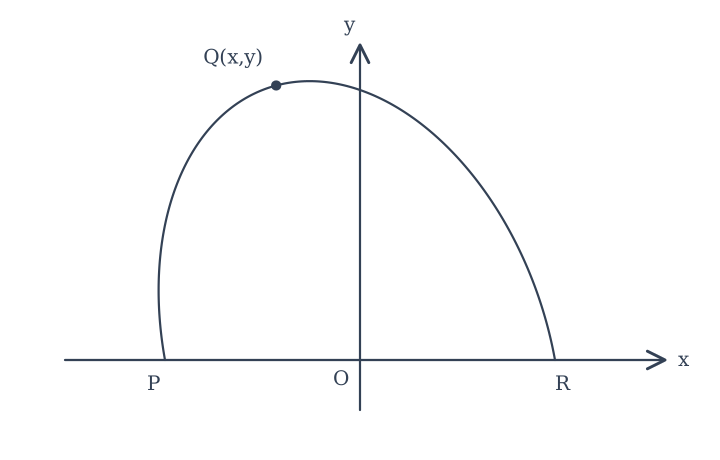
[2013/DHS/I/11]
CJC · Review problems · Question 9
Answer
; . Maximum stationary area at ; at , square units/s.
(i) Find the fixed base
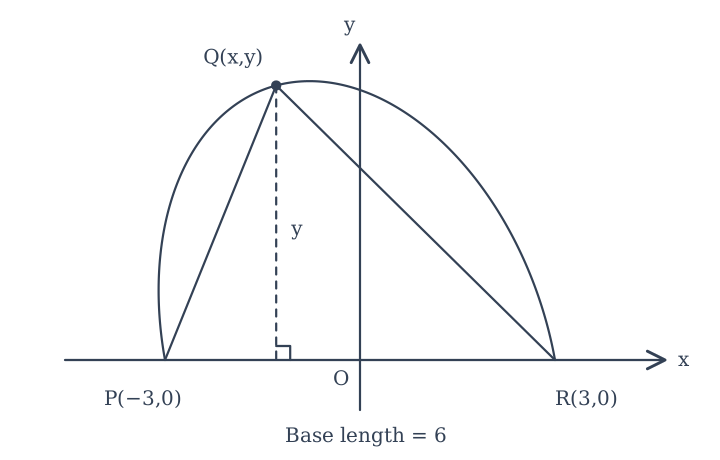
At , , so and . The base length is and perpendicular height is , hence .
(ii) Differentiate the implicit curve
, so and wherever .
(iii) Find the admissible stationary x-value
gives . Substitute into the curve: , so . The positive root would make , so reject it. Thus and .
(iii) Use the second derivative test
Differentiate :
At the stationary point, , , so . Since , the stationary area is a maximum.
Rate method 1: chain through x
At , the upper curve has . The differentiated equation gives , so square units/s. The area decreases at square units/s.
Rate method 2: differentiate directly in time
. At , , so . Hence square units/s, again a decrease of .
Compare your sketch
Expand diagramFit diagram to page
Use the scrollbars or arrow keys to inspect details.
Common mistakes
Keep the negative stationary x-root because the corresponding y-coordinate must be nonnegative.