Porisma

Worked solution

Optimise and differentiate a triangle on an implicit curve

Point Q(x,y)Q(x,y) lies on 4x2+xy+y2=364x^2+xy+y^2=36, with y≥0y\ge0. The curve meets the x-axis at P,RP,R as drawn.

(i) Show that triangle PQRPQR has area A=3yA=3y. marks

(ii) Find dy/dxdy/dx in terms of x,yx,y. marks

(iii) Hence find the x-value where AA is stationary and use the second derivative test to determine its nature. marks

If xx increases at 88 units/s, find the rate of change of AA when x=0x=0. marks

Expand diagram

Use the scrollbars or arrow keys to inspect details.
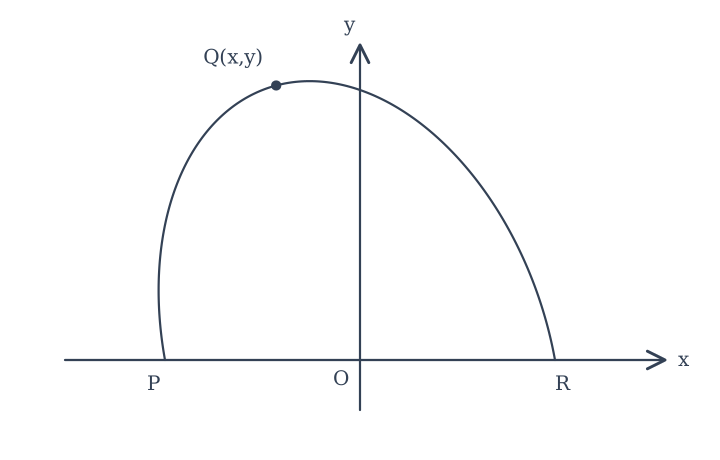
Upper part, y≥0, of the closed curve 4x²+xy+y²=36, with x-axis intersections P and R and a general point Q(x,y) on the upper-left arc. No numerical intercepts are supplied in this given diagram.

[2013/DHS/I/11]

CJC · Review problems · Question 9

Answer

A=3yA=3y; y′=−(8x+y)/(x+2y)y^{\prime}=-(8x+y)/(x+2y). Maximum stationary area at x=−3/5x=-\sqrt{3/5}; at x=0x=0, dA/dt=−12dA/dt=-12 square units/s.

(i) Find the fixed base

At y=0y=0, 4x2=364x^2=36, so P=(−3,0)P=(-3,0) and R=(3,0)R=(3,0). The base length is 66 and perpendicular height is yy, hence A=12(6)y=3yA=\tfrac12(6)y=3y.

How did this part go?

(ii) Differentiate the implicit curve

8x+xy′+y+2yy′=08x+xy^{\prime}+y+2yy^{\prime}=0, so (x+2y)y′=−(8x+y)(x+2y)y^{\prime}=-(8x+y) and dy/dx=−(8x+y)/(x+2y)dy/dx=-(8x+y)/(x+2y) wherever x+2y≠0x+2y\ne0.

How did this part go?

(iii) Find the admissible stationary x-value

A′=3y′=0A^{\prime}=3y^{\prime}=0 gives y=−8xy=-8x. Substitute into the curve: 4x2−8x2+64x2=364x^2-8x^2+64x^2=36, so x2=3/5x^2=3/5. The positive root would make y<0y<0, so reject it. Thus x=−3/5x=-\sqrt{3/5} and y=83/5y=8\sqrt{3/5}.

How did this part go?

(iii) Use the second derivative test

Differentiate 8x+(x+2y)y′+y=08x+(x+2y)y^{\prime}+y=0:

8+(x+2y)y′′+2y′+2(y′)2=0.\begin{aligned}&8+(x+2y)y^{\prime\prime}+2y^{\prime}+2(y^{\prime})^2\\ & =0.\end{aligned}

At the stationary point, y′=0y^{\prime}=0, y=−8xy=-8x, so y′′=−8/(x+2y)=8/(15x)<0y^{\prime\prime}=-8/(x+2y)=8/(15x)<0. Since A′′=3y′′<0A^{\prime\prime}=3y^{\prime\prime}<0, the stationary area is a maximum.

How did this part go?

Rate method 1: chain through x

At x=0x=0, the upper curve has y=6y=6. The differentiated equation gives y′=−1/2y^{\prime}=-1/2, so dA/dt=3(dy/dx)(dx/dt)=3(−1/2)(8)=−12dA/dt=3(dy/dx)(dx/dt)=3(-1/2)(8)=-12 square units/s. The area decreases at 1212 square units/s.

How did this part go?

Rate method 2: differentiate directly in time

8xx˙+xy˙+yx˙+2yy˙=08x\dot x+x\dot y+y\dot x+2y\dot y=0. At x=0x=0, yx˙+2yy˙=0y\dot x+2y\dot y=0, so y˙=−x˙/2=−4\dot y=-\dot x/2=-4. Hence A˙=3y˙=−12\dot A=3\dot y=-12 square units/s, again a decrease of 1212.

How did this part go?

Compare your sketch

Expand diagram

Use the scrollbars or arrow keys to inspect details.
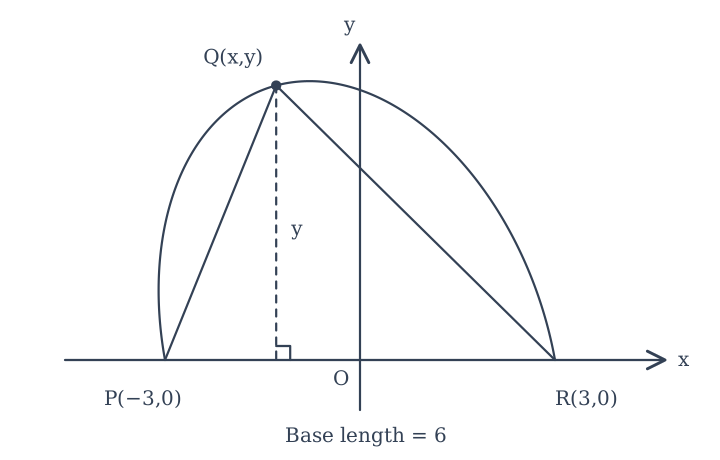
The same upper curve with triangle PQR drawn. Its fixed base runs from P(−3,0) to R(3,0), with vertical height y from Q(x,y) to the x-axis, giving area 3y.

Common mistakes

Keep the negative stationary x-root because the corresponding y-coordinate must be nonnegative.

Read the hint