Porisma

Worked solution

Optimise a flower-bed under a wall-building time budget

A flower-bed for a large garden consists of an xx m by yy m rectangle topped by a semicircle of diameter xx m. A low wall takes 33 hours per metre along the straight parts and 99 hours per metre around the semicircular arc. A total of 180180 hours is available.

Use differentiation to find x,yx,y giving maximum area. marks

Expand diagram

Use the scrollbars or arrow keys to inspect details.
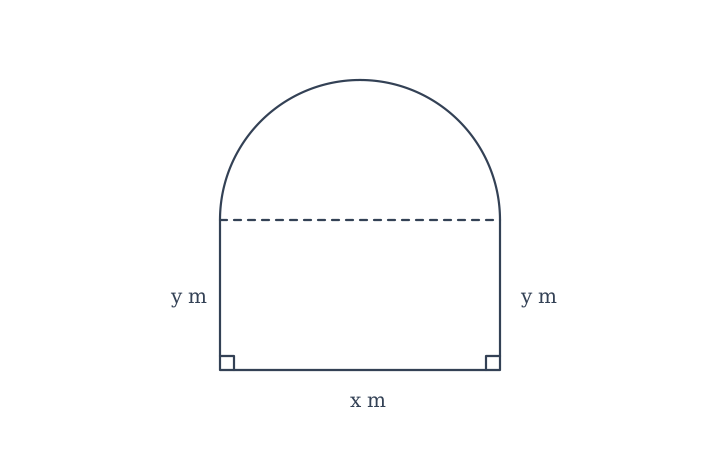
Flower-bed made of a rectangle of width x and height y with a semicircle of diameter x on top. Only the bottom x, two sides y, and outer semicircular arc form the wall; the joining diameter is dashed and internal.

[2008/I/7]

CJC · Review problems · Question 10

Answer

x=120/(4+5π)≈6.09x=120/(4+5\pi)\approx6.09 m, y=60(1+π)/(4+5π)≈12.6y=60(1+\pi)/(4+5\pi)\approx12.6 m (3 s.f.).

Use time, not just perimeter, as the constraint

The exterior straight length is x+2yx+2y and arc length is πx/2\pi x/2. Hence 180=3(x+2y)+9πx/2180=3(x+2y)+9\pi x/2, giving y=30−x/2−3πx/4y=30-x/2-3\pi x/4. The internal semicircle diameter is not an additional wall.

How did this part go?

Form and differentiate the area

A=xy+πx2/8=30x−x2/2−5πx2/8A=xy+\pi x^2/8=30x-x^2/2-5\pi x^2/8. Thus A′=30−x−5πx/4A^{\prime}=30-x-5\pi x/4, so the stationary width is x=120/(4+5π)≈6.0889x=120/(4+5\pi)\approx6.0889 m.

How did this part go?

Find y and verify the maximum

y=60(1+π)/(4+5π)≈12.6y=60(1+\pi)/(4+5\pi)\approx12.6 m. The width is 6.096.09 m to three significant figures, as printed. Since A′′=−1−5π/4<0A^{\prime\prime}=-1-5\pi/4<0, this is a maximum. Both dimensions are positive, so the stationary point is feasible; retain full precision until the final displayed rounding.

How did this part go?

Common mistakes

The arc takes three times as long per metre; a fixed-perimeter model would give the wrong optimum.

Read the hint