Porisma

Worked solution

Maximise a complete globe on a closed cylindrical base

A decorative monument for the 2010 Youth Olympic Games consists of a complete globe on a closed cylindrical base of radius rr and height hh. The globe radius is 1.25r1.25r. To minimise cost, the total surface area is fixed at 36.5 m236.5\text{ m}^2.

(i) Show that h=(146−33πr2)/(8πr)h=(146-33\pi r^2)/(8\pi r). marks

Hence find exactly:

(ii) the cylinder radius giving greatest total volume. marks

(iii) that maximum volume. marks

A sphere of radius RR has area 4πR24\pi R^2 and volume 4πR3/34\pi R^3/3.

Expand diagram

Use the scrollbars or arrow keys to inspect details.
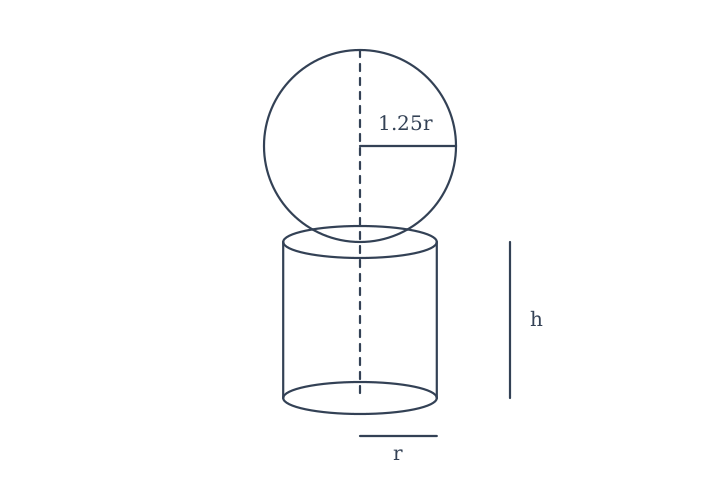
Complete globe above a closed cylindrical base. The globe radius is 1.25r, cylinder radius r and height h. The base has both circular ends; the diagram indicates the full sphere, not a hemisphere.

[2009/CJC/Promo/12]

CJC · Review problems · Question 11

Answer

h=(146−33πr2)/(8πr)h=(146-33\pi r^2)/(8\pi r); optimum r=2/πr=2/\sqrt\pi m; maximum total volume 73/(3π) m373/(3\sqrt\pi)\text{ m}^3.

(i) Count the complete sphere and both cylinder ends

The source surface-area model is

36.5=4π(5r/4)2+2πr2+2πrh.\begin{aligned}&36.5\\ & =4\pi(5r/4)^2+2\pi r^2+2\pi rh.\end{aligned}

Multiplying by four gives 146=33πr2+8πrh146=33\pi r^2+8\pi rh, hence h=(146−33πr2)/(8πr)h=(146-33\pi r^2)/(8\pi r). A positive base requires r>0r>0 and r2<146/(33π)r^2<146/(33\pi).

How did this part go?

(ii) Eliminate h and optimise volume

The complete volume is

V=43π(5r/4)3+πr2h=12548πr3+734r−338πr3=734r−7348πr3.\begin{aligned}&V\\ & =\frac43\pi(5r/4)^3+\pi r^2h\\ & =\frac{125}{48}\pi r^3+\frac{73}{4}r-\frac{33}{8}\pi r^3\\ & =\frac{73}{4}r-\frac{73}{48}\pi r^3.\end{aligned}

Set V′=73/4−73πr2/16=0V^{\prime}=73/4-73\pi r^2/16=0 to obtain r2=4/πr^2=4/\pi. Reject the negative root, giving r=2/πr=2/\sqrt\pi m. It satisfies the positive-height constraint. Since V′′=−73πr/8<0V^{\prime\prime}=-73\pi r/8<0, this is the maximum.

How did this part go?

(iii) Substitute the exact radius

Vmax⁡=(73/4)(2/π)−(73π/48)(2/π)3=73/(2π)−73/(6π)=73/(3π) m3V_{\max}=(73/4)(2/\sqrt\pi)-(73\pi/48)(2/\sqrt\pi)^3=73/(2\sqrt\pi)-73/(6\sqrt\pi)=73/(3\sqrt\pi)\text{ m}^3.

How did this part go?

Common mistakes

Do not omit a cylinder end or treat the globe as a hemisphere.

Read the hint