Porisma
All chapter practice

Applications of differentiation

Practice section 8 of 8

Questions 43–44 in this collection

Practice questions

Review practice · 1 of 2

Maximise a complete globe on a closed cylindrical base

A decorative monument for the 2010 Youth Olympic Games consists of a complete globe on a closed cylindrical base of radius rr and height hh. The globe radius is 1.25r1.25r. To minimise cost, the total surface area is fixed at 36.5 m236.5\text{ m}^2.

(i) Show that h=(146−33πr2)/(8πr)h=(146-33\pi r^2)/(8\pi r). [2]

Hence find exactly:

(ii) the cylinder radius giving greatest total volume. [7]

(iii) that maximum volume. [2]

A sphere of radius RR has area 4πR24\pi R^2 and volume 4πR3/34\pi R^3/3.

Expand diagram

Use the scrollbars or arrow keys to inspect details.
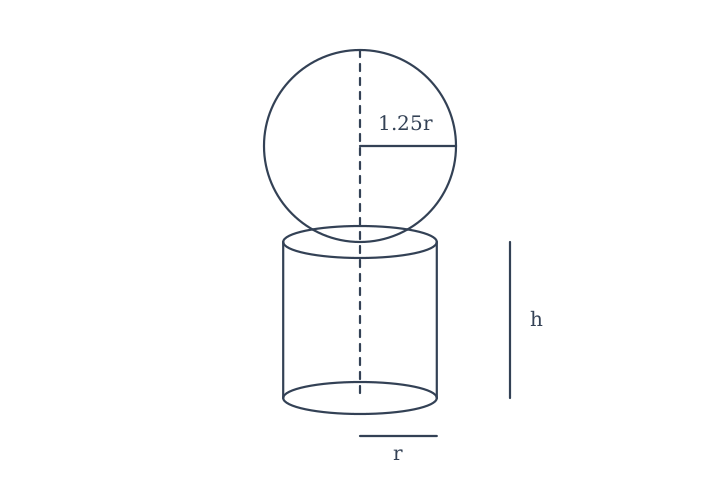
Complete globe above a closed cylindrical base. The globe radius is 1.25r, cylinder radius r and height h. The base has both circular ends; the diagram indicates the full sphere, not a hemisphere.

[2009/CJC/Promo/12]

CJC · Review problems · Question 11

Solution

Review practice · 2 of 2

Optimise corner flower crates around a central pond

A square lawn ABCDABCD has side 2626 m and a circular pond of radius 1111 m centred at its centre PP. A rectangular flower crate QTCSQTCS has corner CC at the square corner and opposite corner QQ on the pond. Let RR be the midpoint of DCDC on the downward centre line. The angle RPQ=θRPQ=\theta is measured from PRPR, with 0≤θ≤π/40\le\theta\le\pi/4. Its base area is X m2X\text{ m}^2.

(i) Express XX in terms of θ\theta and show dX/dθ=11(sin⁡θ−cos⁡θ)(13−11sin⁡θ−11cos⁡θ)dX/d\theta=11(\sin\theta-\cos\theta)(13-11\sin\theta-11\cos\theta). [3]

(ii) For stationary values, show the angles satisfy tan⁡θ1=1\tan\theta_1=1 and sin⁡(θ2+α)=k\sin(\theta_2+\alpha)=k, where k,αk,\alpha are exact constants. Find θ1,θ2\theta_1,\theta_2. [4]

(iii) Classify both stationary values and find their areas. [3]

(iv) Four identical crates are placed at A,B,C,DA,B,C,D, with the rest outside the pond covered by grass. Find the smallest grass area to three significant figures. [3]

Expand diagram

Use the scrollbars or arrow keys to inspect details.
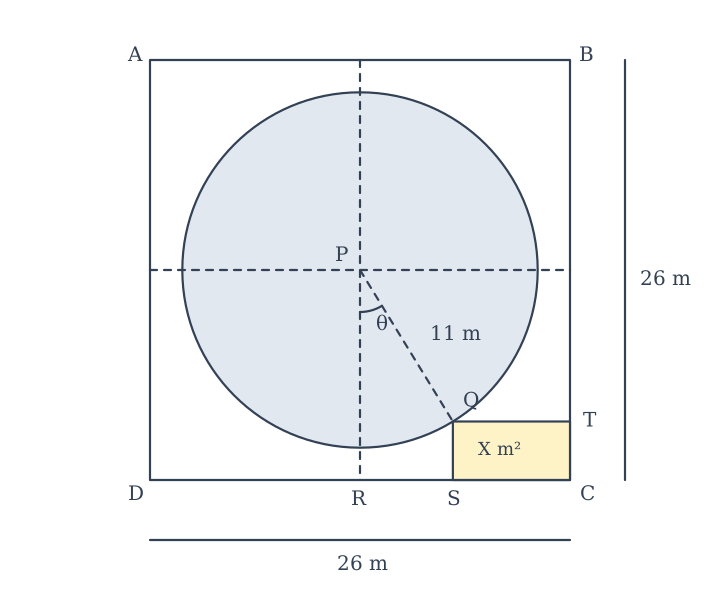
Square ABCD of side 26 m with central circular pond of radius 11 m and centre P. R is the midpoint of bottom side DC. Q lies on the southeast arc, with angle RPQ=theta between downward PR and PQ. Rectangle QTCS occupies the bottom-right corner: T is on BC, S on DC and C is the square corner. Its area is X square metres. The angle is between zero and pi/4.

[2022/SAJC/I/10]

CJC · Review problems · Question 12

Solution

Back to all practice questions