Porisma

Worked solution

Optimise corner flower crates around a central pond

A square lawn ABCDABCD has side 2626 m and a circular pond of radius 1111 m centred at its centre PP. A rectangular flower crate QTCSQTCS has corner CC at the square corner and opposite corner QQ on the pond. Let RR be the midpoint of DCDC on the downward centre line. The angle RPQ=θRPQ=\theta is measured from PRPR, with 0≤θ≤π/40\le\theta\le\pi/4. Its base area is X m2X\text{ m}^2.

(i) Express XX in terms of θ\theta and show dX/dθ=11(sin⁡θ−cos⁡θ)(13−11sin⁡θ−11cos⁡θ)dX/d\theta=11(\sin\theta-\cos\theta)(13-11\sin\theta-11\cos\theta). marks

(ii) For stationary values, show the angles satisfy tan⁡θ1=1\tan\theta_1=1 and sin⁡(θ2+α)=k\sin(\theta_2+\alpha)=k, where k,αk,\alpha are exact constants. Find θ1,θ2\theta_1,\theta_2. marks

(iii) Classify both stationary values and find their areas. marks

(iv) Four identical crates are placed at A,B,C,DA,B,C,D, with the rest outside the pond covered by grass. Find the smallest grass area to three significant figures. marks

Expand diagram

Use the scrollbars or arrow keys to inspect details.
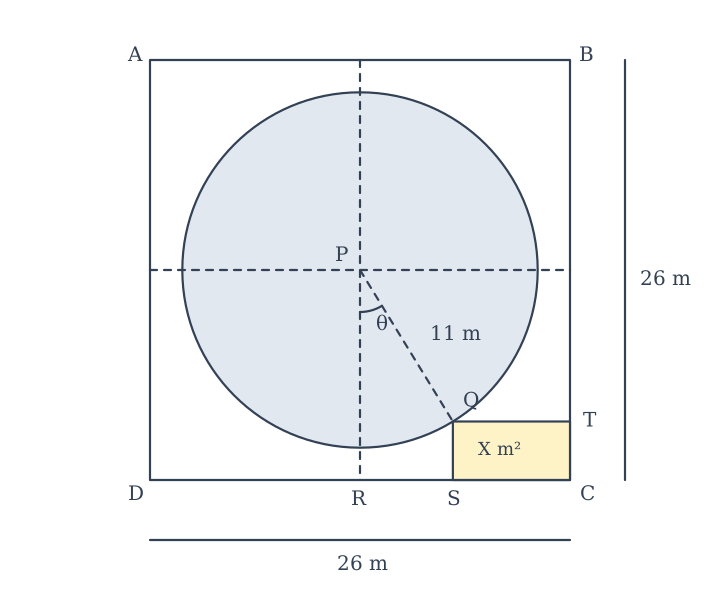
Square ABCD of side 26 m with central circular pond of radius 11 m and centre P. R is the midpoint of bottom side DC. Q lies on the southeast arc, with angle RPQ=theta between downward PR and PQ. Rectangle QTCS occupies the bottom-right corner: T is on BC, S on DC and C is the square corner. Its area is X square metres. The angle is between zero and pi/4.

[2022/SAJC/I/10]

CJC · Review problems · Question 12

Answer

θ1=π/4\theta_1=\pi/4, θ2=arcsin⁡(13/(112))−π/4≈0.20396\theta_2=\arcsin(13/(11\sqrt2))-\pi/4\approx0.20396; minimum crate area 24 m224\text{ m}^2, maximum 459/2−1432 m2459/2-143\sqrt2\text{ m}^2; smallest grass area 187 m2187\text{ m}^2 (3 s.f.).

(i) Form the area and factor its derivative

The horizontal and vertical crate sides are 13−11sin⁡θ13-11\sin\theta and 13−11cos⁡θ13-11\cos\theta, so

X=(13−11sin⁡θ)(13−11cos⁡θ).X=(13-11\sin\theta)(13-11\cos\theta).

The product rule gives X′=−143cos⁡θ+121cos⁡2θ+143sin⁡θ−121sin⁡2θX^{\prime}=-143\cos\theta+121\cos^2\theta+143\sin\theta-121\sin^2\theta. Using cos⁡2θ−sin⁡2θ=(cos⁡θ−sin⁡θ)(cos⁡θ+sin⁡θ)\cos^2\theta-\sin^2\theta=(\cos\theta-\sin\theta)(\cos\theta+\sin\theta),

X′=11(sin⁡θ−cos⁡θ)(13−11sin⁡θ−11cos⁡θ).X^{\prime}=11(\sin\theta-\cos\theta)(13-11\sin\theta-11\cos\theta).

How did this part go?

(ii) Solve both stationary equations in the interval

The first factor gives tan⁡θ1=1\tan\theta_1=1, hence θ1=π/4\theta_1=\pi/4. The other gives sin⁡θ+cos⁡θ=13/11\sin\theta+\cos\theta=13/11, or

sin⁡(θ2+π/4)=13112.\sin(\theta_2+\pi/4)=\frac{13}{11\sqrt2}.

Thus α=π/4\alpha=\pi/4, k=13/(112)k=13/(11\sqrt2) and θ2=arcsin⁡(13/(112))−π/4≈0.20395638\theta_2=\arcsin(13/(11\sqrt2))-\pi/4\approx0.20395638 rad (printed 0.203960.20396). The supplementary sine solution is outside [0,π/4][0,\pi/4] and is rejected.

How did this part go?

(iii) Method 1: use signs within the physical interval

The printed sign charts give a negative-to-positive change at θ2\theta_2 and positive-to-negative across π/4\pi/4 in the smooth extension. In the actual allowed interval, X′<0X^{\prime}<0 on (0,θ2)(0,\theta_2) and X′>0X^{\prime}>0 on (θ2,π/4)(\theta_2,\pi/4). Thus θ2\theta_2 is a minimum and π/4\pi/4 is the right-endpoint maximum candidate. The source’s test immediately to the right of π/4\pi/4 lies outside the stated geometric interval; comparing endpoint values below establishes the global maximum without that extra sample.

How did this part go?

(iii) Method 2: second derivative and the missing area value

The printed second derivative is X′′=143(sin⁡θ+cos⁡θ)−484sin⁡θcos⁡θX^{\prime\prime}=143(\sin\theta+\cos\theta)-484\sin\theta\cos\theta. At π/4\pi/4 this is 1432−242≈−39.8<0143\sqrt2-242\approx-39.8<0. At θ2\theta_2, sin⁡θ+cos⁡θ=13/11\sin\theta+\cos\theta=13/11 and sin⁡θcos⁡θ=24/121\sin\theta\cos\theta=24/121, so X′′=169−96=73>0X^{\prime\prime}=169-96=73>0 (the source’s rounded-angle calculation prints 72.99972.999).

The requested area values are Xmin⁡=24 m2X_{\min}=24\text{ m}^2 at θ2\theta_2, and Xmax⁡=(13−11/2)2=459/2−1432≈27.26746058 m2X_{\max}=(13-11/\sqrt2)^2=459/2-143\sqrt2\approx27.26746058\text{ m}^2 at π/4\pi/4. The source omits the minimum area despite asking for it, so it is supplied explicitly here. Since X(0)=26<X(π/4)X(0)=26<X(\pi/4), this endpoint is also the global maximum on the permitted interval.

How did this part go?

(iv) Subtract the pond and four maximal crates

The four corner crates do not overlap and their interiors lie outside the pond. Use the maximum crate area, retaining full precision:

Gmin⁡=262−4(13−11/2)2−π(11)2=5722−242−121π≈186.79744659 m2.\begin{aligned}&G_{\min}\\ & =26^2-4(13-11/\sqrt2)^2\\ &{}-\pi(11)^2\\ & =572\sqrt2-242\\ &{}-121\pi\approx186.79744659\text{ m}^2.\end{aligned}

Hence the smallest grass area is 187 m2187\text{ m}^2 to three significant figures, agreeing with the printed answer. The source substitutes the rounded crate area 27.327.3; the exact calculation avoids that intermediate rounding.

How did this part go?

Common mistakes

The right side of pi/4 lies outside the allowed interval; check the other endpoint before claiming a global maximum.

Read the hint