A hint to get started
Count first-winning throws and distinguish payout from net gain
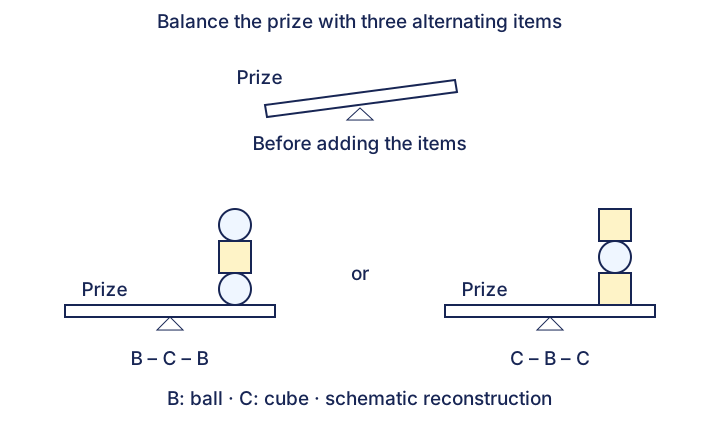
A player wins by balancing a beam with three alternating items: ball–cube–ball or cube–ball–cube, as shown. An unbiased die determines each item: scores 1 or 2 give a ball; otherwise a cube. The player has at most 5 throws. An item of the same type as the last accepted item is rejected.
Let X be the number of throws required to win. Show that . marks
Find the probability of winning. marks
The entry fee is a dollars. A win on throw 3 pays back 2 a dollars, on throw 4 pays back a/2 dollars, and on throw 5 pays back a/3 dollars. Find a if the owner expects a profit of 1.20 dollars per game. marks
Expand diagramFit diagram to page
Use the scrollbars or arrow keys to inspect details.
[2006/NJC/II/29(OR)]
CJC · Review problems · Question 12
A rejected repeat consumes a throw but leaves the most recently accepted item unchanged.