Worked solution
Connect a derivative discriminant to the missing range
· Techniques of Differentiation
, x≠a, where a is a non-zero constant.
(i) Given the oblique asymptote y=x+2, find a. mark
(ii) Find the set of values of a if C has two turning points. marks
(iii) Using a from (i) and an algebraic method, show C cannot exist for y₁<y<y₂, determining y₁,y₂ exactly. marks
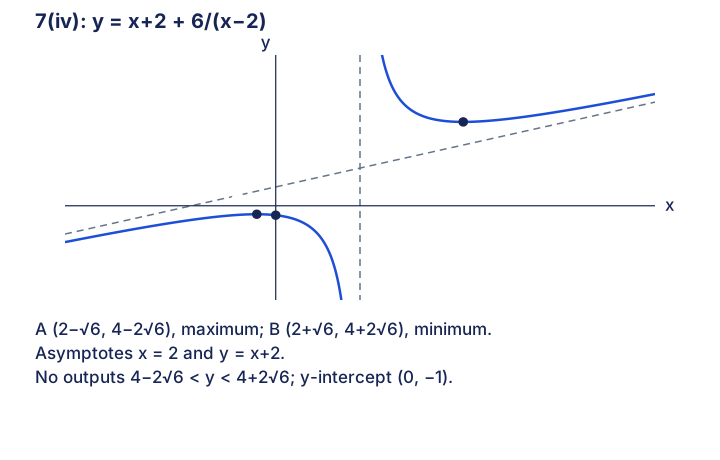
(iv) Hence sketch C, clearly showing the asymptotes and stationary-point coordinates. marks
[2010/NYJC/Promo/10]
CJC · Review problems · Question 7
Answer
a=2; two turns for a<−1 or a>0; missing interval .
(i) Divide and compare the oblique asymptote
. Its oblique asymptote is y=x+a; comparison with y=x+2 gives a=2.
(ii) Require two distinct derivative zeros
. Setting this equal to zero gives . Two turns require , hence , or . Therefore . In these intervals a²+a>0, so neither derivative zero is the excluded input x=a; the simple zeros change derivative sign.
(iii) Form a quadratic in x for a horizontal level
For a=2, , x≠2. Then , giving . To have no real x, require , or .
(iii) Solve the two boundary levels exactly
The boundary roots are . Thus is missing, with and .
(iv) Put the exact boundary points on the sketch
, x≠2. The asymptotes are x=2 and y=x+2. The stationary points are , a maximum, and , a minimum. The y-intercept is (0,−1); x²+2>0 rules out x-intercepts.
Compare your sketch
Expand diagramFit diagram to page
Use the scrollbars or arrow keys to inspect details.
Common mistakes
The boundary levels themselves occur at the stationary points; exclude only the open interval.
Solution notes
The exact boundary levels are included in the range, not in the missing interval.