Porisma

Worked solution

Keep the trigonometric range and solve an intersection exactly

(a) Find the cartesian equation for x=cos⁡θx=\cos\theta, y=2sin⁡2θy=2\sin^2\theta. marks

(b) A curve has x=t3+tx=t^3+t, y=2t−1y=2t-1, −1≤t≤1-1\le t\le1.

(i) Sketch the curve, indicating its axial intercepts. marks

(ii) Without using a calculator, find its intersection with y=12y=\tfrac12. marks

[2010/CJC/MYE/2(modified)]

CJC · Review problems · Question 3

Answer

(a) y=2(1−x2)y=2(1-x^2), −1≤x≤1-1\le x\le1. (b) Intercepts (0,−1)(0,-1), (5/8,0)(5/8,0); intersection (75/64,1/2)(75/64,1/2).

(a) Eliminate the angle and retain its range

sin⁡2θ+cos⁡2θ=1\sin^2\theta+\cos^2\theta=1 gives y/2+x2=1y/2+x^2=1, so y=2(1−x2)y=2(1-x^2) with −1≤x≤1-1\le x\le1. The unrestricted parabola would include points impossible for x=cos⁡θx=\cos\theta.

How did this part go?

(b)(i) Find the intercepts and restricted endpoints

x=0x=0 gives t(t2+1)=0t(t^2+1)=0, hence (0,−1)(0,-1). For y=0y=0, t=1/2t=1/2 and x=1/8+1/2=5/8=0.625x=1/8+1/2=5/8=0.625, hence (5/8,0)(5/8,0). The closed endpoints are (−2,−3)(-2,-3) at t=−1t=-1 and (2,1)(2,1) at t=1t=1. Since dx/dt=3t2+1>0dx/dt=3t^2+1>0 and dy/dt=2dy/dt=2, the curve increases throughout. Its slope is largest at t=0t=0, giving the smooth bend through (0,−1)(0,-1).

How did this part go?

(b)(ii) Use the easy coordinate first

At y=1/2y=1/2, 1/2=2t−11/2=2t-1 gives t=3/4t=3/4, which is allowed. Then x=(3/4)3+3/4=27/64+48/64=75/64x=(3/4)^3+3/4=27/64+48/64=75/64. The intersection is (75/64,1/2)(75/64,1/2).

How did this part go?

Compare your sketch

Expand diagram

Use the scrollbars or arrow keys to inspect details.
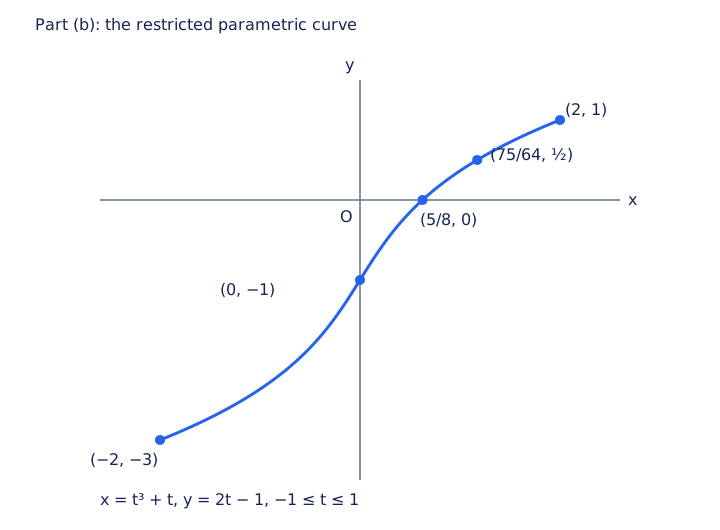
The part (b) curve increases from filled endpoint (−2,−3), through (0,−1) and (5/8,0), to filled endpoint (2,1). The exact intersection with y=1/2 is (75/64,1/2).

Common mistakes

Eliminating a trigonometric parameter must preserve its attainable coordinate range.

Read the hint