Worked solution
Bound the part of C lying in B but outside A
, and .
(i) Find . marks
(ii) Find . marks
A third event C has and is independent of A.
(iii) Find . mark
(iv) Hence show that . marks
[2014/AJC/II/7]
CJC · Review problems · Question 4
Answer
(i) ; (ii) ; (iii) ; (iv) .
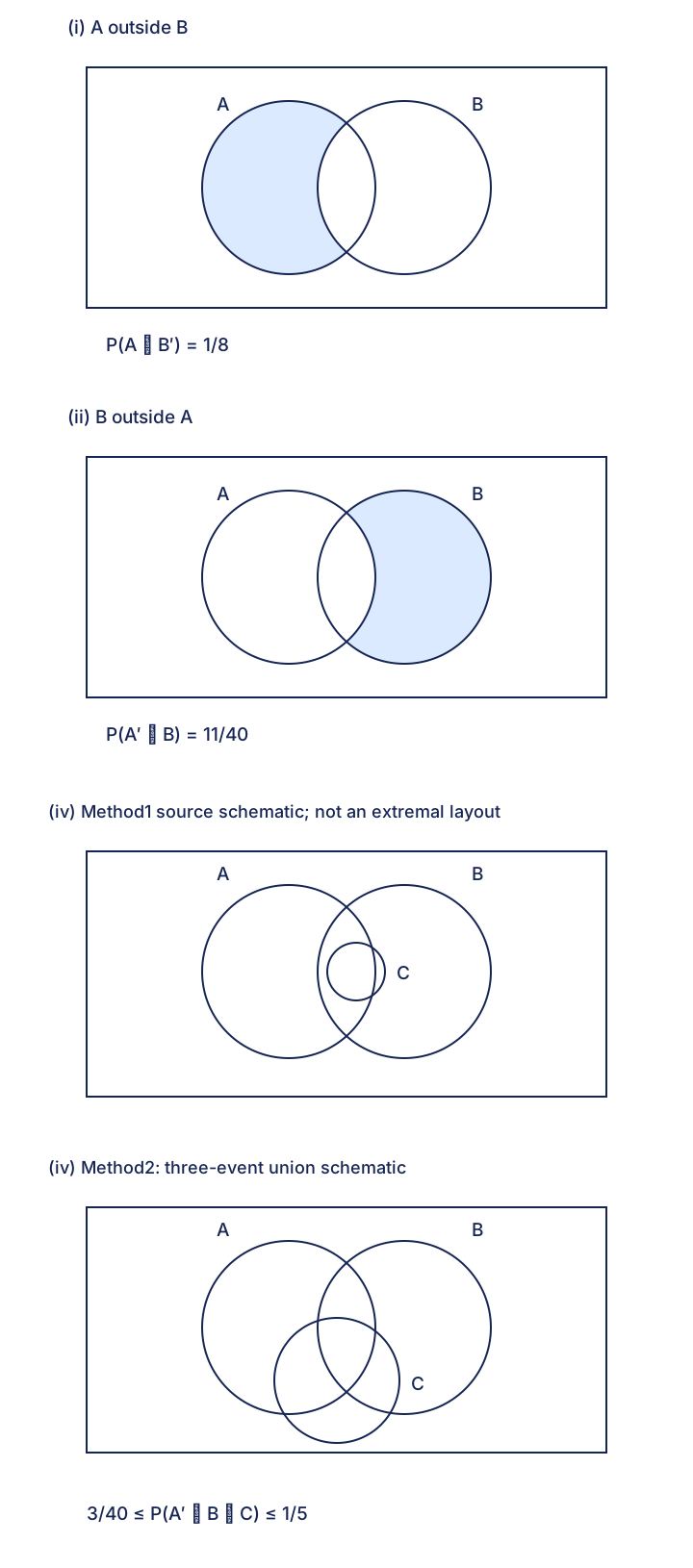
(i) Remove A outside B
. Therefore .
(ii) Divide B-only by the union
Within , the part outside A is exactly . Its probability is . The union is . Thus .
(iii) Independence passes to the complement
Since A and C are independent, A′ and C are independent. Hence .
(iv) Upper bound
The event is contained in , so its probability is at most 1/5. Equality holds if all of the latter event lies in B.
(iv) Lower bound, source method 1: outside-B capacity
. Of the mass , at most 1/8 can lie outside B, so at least lies in B. The source’s small-C sketch is schematic and does not itself demonstrate the extremal placement; the probability-capacity argument establishes the bound.
(iv) Lower bound, source method 2: union cannot exceed 1
. With , this gives . Combining bounds proves .
Compare your sketch
Expand diagramFit diagram to page
Use the scrollbars or arrow keys to inspect details.
Common mistakes
C is independent of A; no independence with B is given. Use set containment/capacity for the bounds.
Solution notes
All four asks, all source algebra, both lower-bound methods and four diagram panels retained. Source diagrams are not area-proportional; the Method 1 small-C sketch does not demonstrate a minimum-overlap position, so the algebraic bound is explained independently. Original native text unchanged.