Porisma

Worked solution

Sum the rows of a triangular labelled board

The n-th row from the top of a board has n tiles, labelled 1,2,…,n1,2,\ldots,n from left to right, as in the diagram. Given ∑r=1nr2=n(n+1)(2n+1)/6\sum_{r=1}^nr^2=n(n+1)(2n+1)/6, find the sum in the k-th row and hence show the sum of all numbers in n rows is n(n+1)(n+2)/6n(n+1)(n+2)/6. marks

Expand diagram

Use the scrollbars or arrow keys to inspect details.
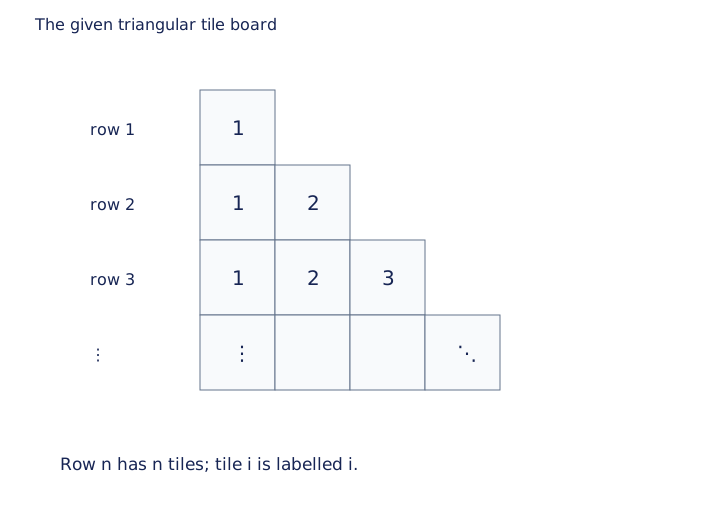
Given triangular tile board: first row is 1; second row 1,2; third row 1,2,3; ellipses continue the pattern. Every row starts again at 1.

[2017/NYJC/I/1]

CJC · Review problems · Question 10

Answer

Row k: k(k+1)/2k(k+1)/2; all n rows: n(n+1)(n+2)/6n(n+1)(n+2)/6.

Find a general row total

The k-th row contains 1+2+⋯+k1+2+\cdots+k, so its sum is k(k+1)/2k(k+1)/2.

How did this part go?

Sum the row totals and apply both standard formulas

The total is ∑k=1nk(k+1)/2=12∑k=1n(k2+k)=n(n+1)(2n+1)/12+n(n+1)/4=n(n+1)(2n+4)/12=n(n+1)(n+2)/6\sum_{k=1}^nk(k+1)/2=\tfrac12\sum_{k=1}^n(k^2+k)=n(n+1)(2n+1)/12+n(n+1)/4=n(n+1)(2n+4)/12=n(n+1)(n+2)/6.

How did this part go?

Common mistakes

There are k tiles in row k; the row total is not k squared.

Read the hint