Review practice · Section 2 of 4
Questions 7–12 in this collection
Shift both bounds before applying a prefix formula · Separate odd-index and even-index denominator terms · +4 more
- 7
Given , show
marks[2013/SRJC/Promo/10(modified)]
CJC · Review problems · Question 7
- 8
Given :
(i) Deduce for all positive integers . mark
(ii) Given also , find . marks
(iii) Use these results to find in terms of . marks
[2012/VJC/Promo/13(modified)]
CJC · Review problems · Question 8
- 9
Given , deduce . marks
[2013/JJC/I/3(modified)]
CJC · Review problems · Question 9
- 10
The n-th row from the top of a board has n tiles, labelled from left to right, as in the diagram. Given , find the sum in the k-th row and hence show the sum of all numbers in n rows is . marks
Expand diagramFit diagram to page
Use the scrollbars or arrow keys to inspect details.
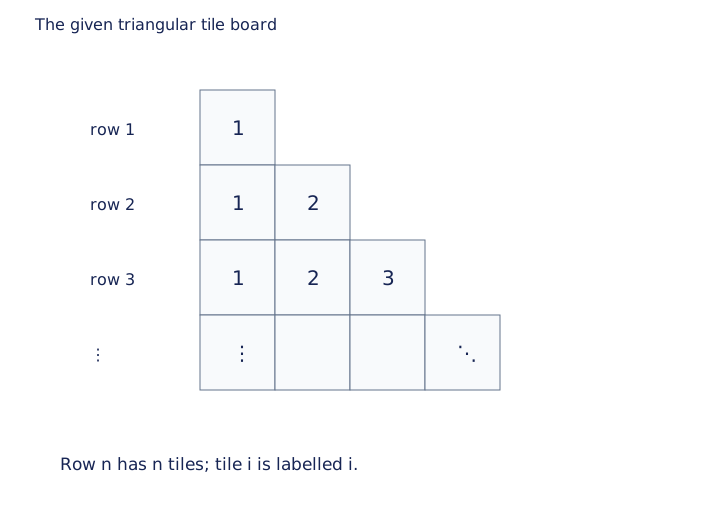
Given triangular tile board: first row is 1; second row 1, 2; third row 1, 2, 3; ellipses continue the pattern. Every row starts again at 1. [2017/NYJC/I/1]
CJC · Review problems · Question 10
- 11
The sequence begins , , , , … .
(i) Show its n-th term is . marks
(ii) Find the sum of its first n terms. marks
[2013/VJC/Promo/1]
CJC · Review problems · Question 11
- 12
Find the first seven terms of , , and a formula for .
CJC · Review problems · Question 12