Porisma

A hint to get started

Transform the given graph f(2x) without doubling a scale factor

The given graph is y=f(2x)y=f(2x), passing through A=(−1,0), B=(0,2), C=(1,0), D=(3,−3). The diagram shows a right-hand horizontal asymptote y=−1.

Sketch on separate clearly labelled diagrams:

(i) y=f(−2x)y=f(-2x); mark

(ii) y=f(2−2x)y=f(2-2x); marks

(iii) y=12f(2x)y=\frac12f(2x). marks

Expand diagram

Use the scrollbars or arrow keys to inspect details.
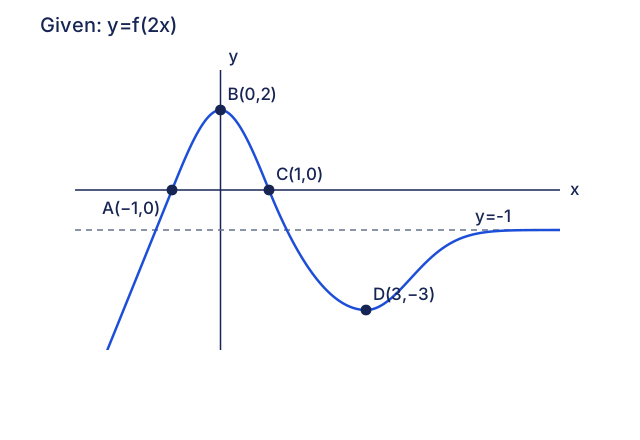
Reconstructed source schematic y=f(2x), through A(-1,0),B(0,2),C(1,0),D(3,-3), with right-hand horizontal asymptote y=-1. Curve geometry between given landmarks is qualitative, not a supplied formula.

[2012/VJC/Promo/4]

CJC · Review problems · Question 1

Name the supplied graph g(x)=f(2x), then express each requested graph in terms of g.

Read the worked solution