Review practice · Section 1 of 2
Questions 1–6 in this collection
Transform the given graph f(2x) without doubling a scale factor · Map labelled points and preserve reciprocal domains · +4 more
- 1
The given graph is , passing through A=(−1,0), B=(0,2), C=(1,0), D=(3,−3). The diagram shows a right-hand horizontal asymptote y=−1.
Sketch on separate clearly labelled diagrams:
(i) ; mark
(ii) ; marks
(iii) . marks
Expand diagramFit diagram to page
Use the scrollbars or arrow keys to inspect details.
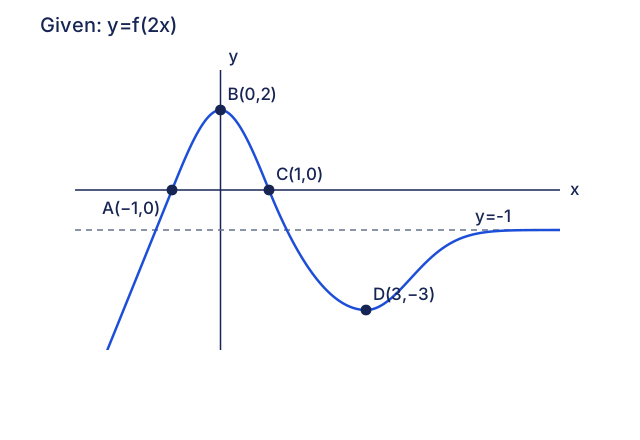
Reconstructed source schematic y=f(2x), through A(-1,0), B(0,2), C(1,0), D(3,-3), with right-hand horizontal asymptote y=-1. Curve geometry between given landmarks is qualitative, not a supplied formula. [2012/VJC/Promo/4]
CJC · Review problems · Question 1
- 2
The given graph is , with maximum A=(2,2), B=(4,0), C=(0,1) and vertical asymptote x=5; its left tail approaches y=0. Sketch on separate diagrams:
(i) ; marks
(ii) ; marks
(iii) ; marks
Show the corresponding A,B,C coordinates and all asymptotes where applicable.
Expand diagramFit diagram to page
Use the scrollbars or arrow keys to inspect details.
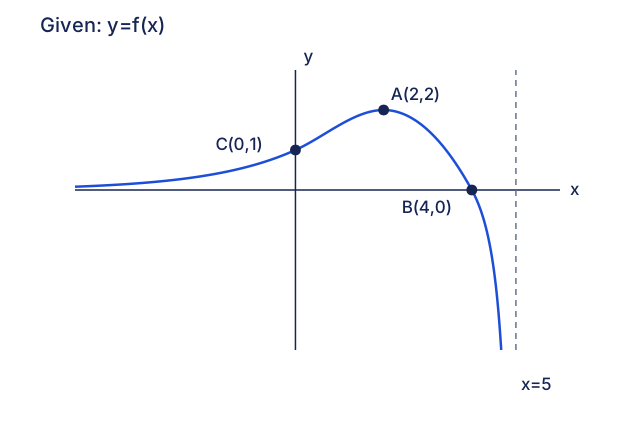
Source schematic y=f(x), A(2,2) maximum, C(0,1), B(4,0), vertical asymptote x=5 and left tail tending to y=0. Only the supplied branch x<5 is reconstructed. Interpolation is qualitative. CJC · Review problems · Question 2
- 3
The given graph intersects the axes at A=(0,−2), B=(−1,0), has minimum C=(4,0.5), and asymptotes x=1, y=3.
Sketch separately:
(i) ; marks
(ii) ; marks
Clearly indicate asymptotes, axial intercepts and corresponding A,B,C where appropriate.
Expand diagramFit diagram to page
Use the scrollbars or arrow keys to inspect details.
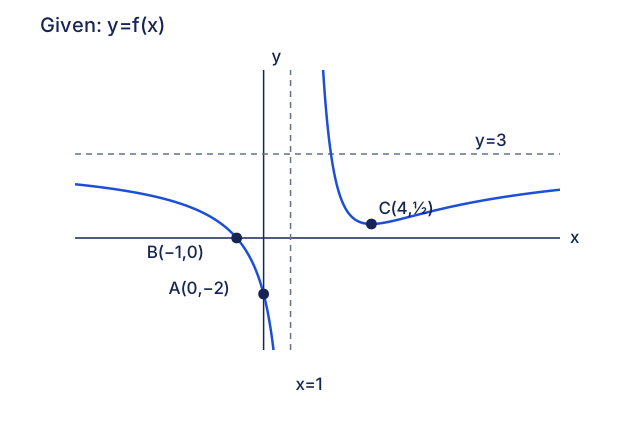
Source schematic with A(0,-2), B(-1,0), minimum C(4,1/2), asymptotes x=1, y=3. Branch shapes are qualitative and reproduce the stated landmarks and limiting behavior. [2010/HCI/Promo/5]
CJC · Review problems · Question 3
- 4
(a) is translated 3 units in the positive x-direction, stretched by factor 2 parallel to y, then translated 2 units in the negative y-direction. Find the new equation as . marks
(b) Three successive transformations change to . Describe them. marks
[2011/CJC/MYE/11(modified)]
CJC · Review problems · Question 4
- 5
The given graph has asymptotes , , turning point , and zeros , , .
(a) State the turning point of . mark
(b) Sketch , labelling asymptotes and the points corresponding to A,B,C. marks
(c) Sketch with those labels. marks
(d) Sketch , labelling asymptotes, turning points and axis crossings. marks
Expand diagramFit diagram to page
Use the scrollbars or arrow keys to inspect details.
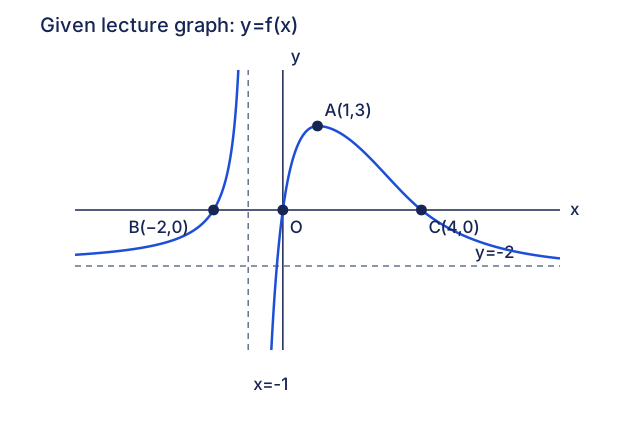
Qualitative reconstruction checked against the actual given graph in lecture Student PDF 38 / printed 110 and Teacher PDF 39 / printed 111: A(1,3), B(−2,0), O(0,0), C(4,0), asymptotes x=−1, y=−2, with the source branch directions. The standalone solution PDF omits that original figure; no unique formula is inferred. [2022/YIJC/Promo/6]
CJC · Review problems · Question 5
- 6
A reflects in the y-axis; B translates 4 units in the positive x-direction; C scales parallel to y by 2. A curve undergoes A,B,C in that order, giving . Determine its equation before the transformations. marks
[2010/DHS/Promo/6(a)]
CJC · Review problems · Question 6