Worked solution
Map labelled points and preserve reciprocal domains
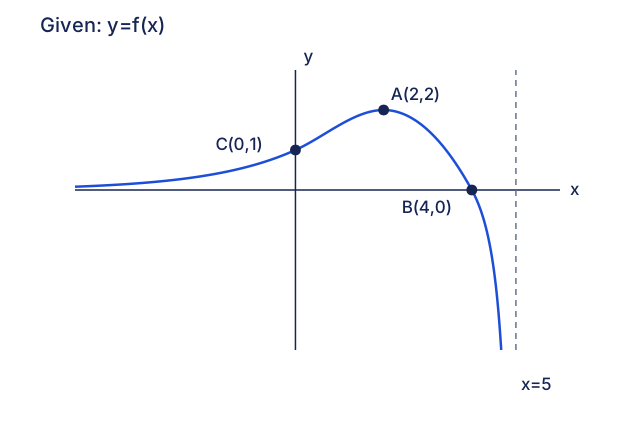
The given graph is , with maximum A=(2,2), B=(4,0), C=(0,1) and vertical asymptote x=5; its left tail approaches y=0. Sketch on separate diagrams:
(i) ; marks
(ii) ; marks
(iii) ; marks
Show the corresponding A,B,C coordinates and all asymptotes where applicable.
Expand diagramFit diagram to page
Use the scrollbars or arrow keys to inspect details.
CJC · Review problems · Question 2
Answer
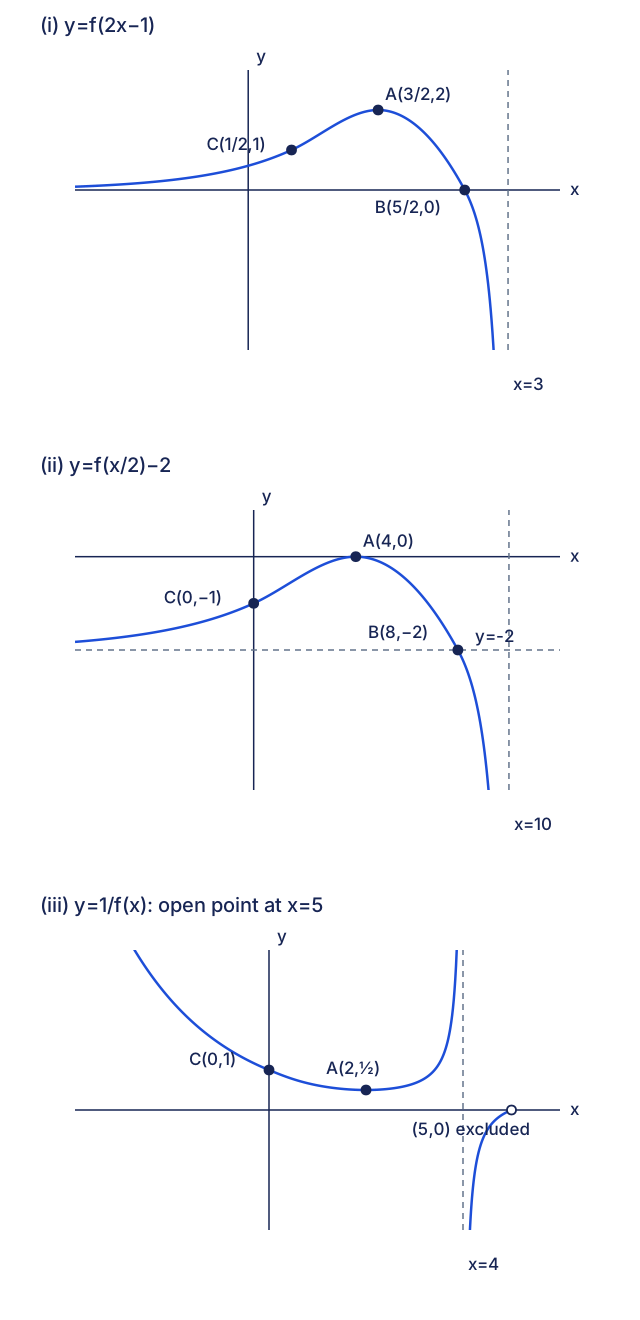
(i) A(3/2,2), B(5/2,0), C(1/2,1), x=3.
(ii) A(4,0), B(8,−2), C(0,−1), x=10, y=−2.
(iii) A(2,1/2), C(0,1), vertical asymptote x=4; (5,0) excluded.
(i) Follow the source two-step transformation
Translate the original one unit in the positive x-direction: . Scale parallel to the x-axis by 1/2: . The point map is , giving A=(3/2,2), B=(5/2,0), C=(1/2,1). The vertical asymptote moves from x=5 to x=3; the left limiting horizontal asymptote remains y=0.
(ii) Stretch horizontally, then translate down
Scale parallel to x by 2 to obtain , then translate 2 units down to . The point map gives A=(4,0), B=(8,−2), C=(0,−1). The asymptotes are x=10 and y=−2.
(iii) Reciprocate ordinates where defined
A becomes (2,1/2), a minimum, and C remains (0,1). B has f(4)=0, so x=4 is a reciprocal vertical asymptote, not a finite image point. On the shown branch, as x→5−, but f is undefined at x=5. Therefore (5,0) is an open limiting point, not an x-intercept. The reciprocal has no x-intercepts; its y-intercept is (0,1). The shown reciprocal left branch grows without bound as x→−∞, so y=0 is not a horizontal asymptote of that branch.
Compare your sketch
Expand diagramFit diagram to page
Use the scrollbars or arrow keys to inspect details.
Common mistakes
The printed reciprocal sketch fills(5,0), although f is undefined at its vertical asymptote x=5. A limiting value does not add a domain point.
Solution notes
All printed asks and both affine transformation chains retained. The source reciprocal endpoint is explicitly corrected to an open point. Only the branch supplied in the PDF is reconstructed; no unsupported branch beyond x=5 is invented. Original native text and original closed-dot diagram remain the source evidence.