Worked solution
Reflect a two-branch graph and handle a reciprocal hole
The given graph intersects the axes at A=(0,−2), B=(−1,0), has minimum C=(4,0.5), and asymptotes x=1, y=3.
Sketch separately:
(i) ; marks
(ii) ; marks
Clearly indicate asymptotes, axial intercepts and corresponding A,B,C where appropriate.
Expand diagramFit diagram to page
Use the scrollbars or arrow keys to inspect details.
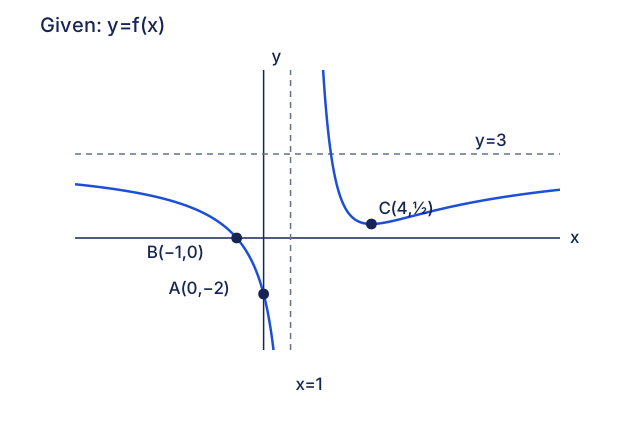
[2010/HCI/Promo/5]
CJC · Review problems · Question 3
Answer
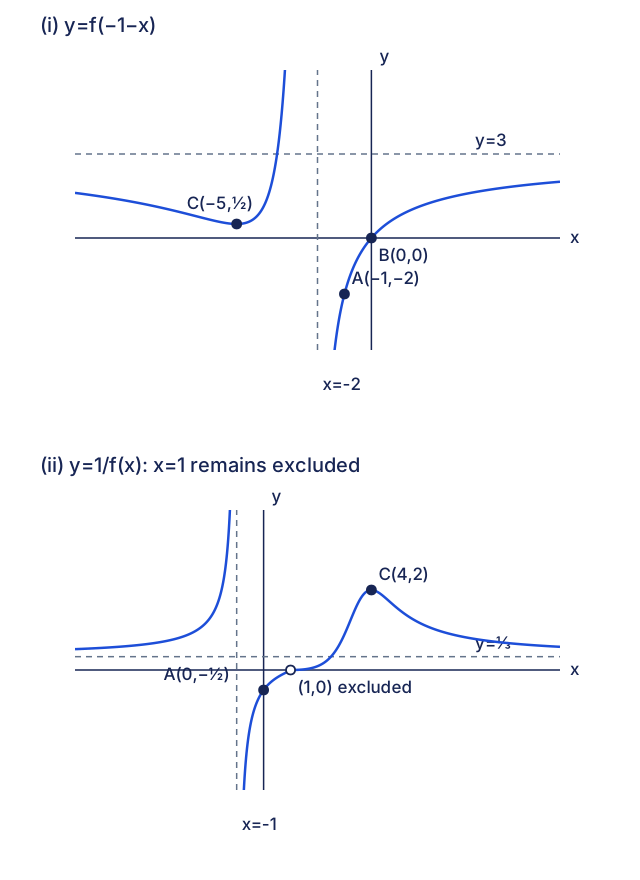
(i) A(−1,−2), B(0,0), C(−5,1/2), asymptotes x=−2, y=3.
(ii) A(0,−1/2), C(4,2), asymptotes x=−1, y=1/3; open point (1,0), no x-intercept.
(i) Apply the horizontal point map
The input replacement −1−x maps each source point to . Thus A=(−1,−2), B=(0,0), C=(−5,1/2). The vertical asymptote x=1 maps to x=−2; horizontal y=3 remains. B is both the x- and y-intercept of the transformed curve, as shown in the source.
(ii) Reciprocate finite nonzero ordinates
A becomes (0,−1/2), the y-intercept. C becomes (4,2), a maximum on its positive branch. The zero at B becomes a vertical asymptote x=−1. The horizontal asymptote y=3 becomes y=1/3.
(ii) Preserve the excluded original asymptote input
The original is undefined at x=1. Its unbounded one-sided values yield reciprocal limits of 0, but (1,0) remains excluded. Draw an open point there; no actual x-intercept occurs. The source sketch runs through that limiting location without marking the domain exclusion, so the authored sketch and qualification make it explicit.
Compare your sketch
Expand diagramFit diagram to page
Use the scrollbars or arrow keys to inspect details.
Common mistakes
A finite zero limit of 1/f at an original vertical asymptote does not make that input part of the reciprocal domain.
Solution notes
All source landmarks, branch directions and asymptotes retained in independent qualitative sketches. Domain exclusion at x=1 is explicit rather than silently adopting the source’s unmarked zero-limit crossing.