Porisma

A hint to get started

Reflect a two-branch graph and handle a reciprocal hole

The given graph y=f(x)y=f(x) intersects the axes at A=(0,−2), B=(−1,0), has minimum C=(4,0.5), and asymptotes x=1, y=3.

Sketch separately:

(i) y=f(−1−x)y=f(-1-x); marks

(ii) y=1/f(x)y=1/f(x); marks

Clearly indicate asymptotes, axial intercepts and corresponding A,B,C where appropriate.

Expand diagram

Use the scrollbars or arrow keys to inspect details.
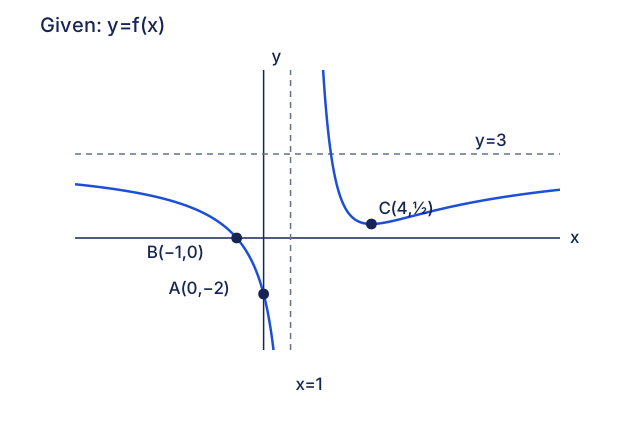
Source schematic with A(0,-2),B(-1,0), minimum C(4,1/2), asymptotes x=1,y=3. Branch shapes are qualitative and reproduce the stated landmarks and limiting behavior.

[2010/HCI/Promo/5]

CJC · Review problems · Question 3

For a reciprocal, distinguish f’s zeros from inputs where f itself is undefined.

Read the worked solution