Worked solution
Compare modulus, negative scaling and reciprocal graphs
The given graph has asymptotes , , turning point , and zeros , , .
(a) State the turning point of . mark
(b) Sketch , labelling asymptotes and the points corresponding to A,B,C. marks
(c) Sketch with those labels. marks
(d) Sketch , labelling asymptotes, turning points and axis crossings. marks
Expand diagramFit diagram to page
Use the scrollbars or arrow keys to inspect details.
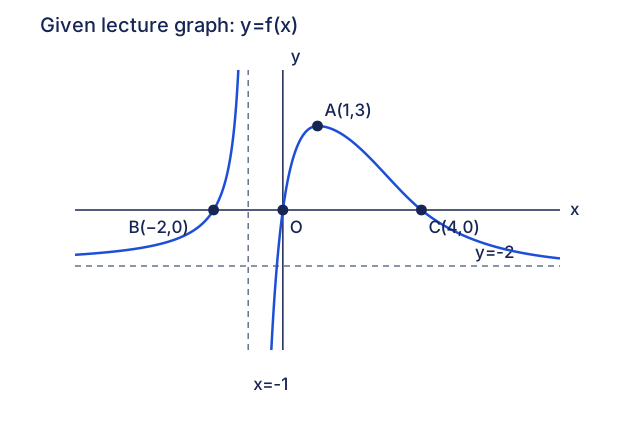
[2022/YIJC/Promo/6]
CJC · Review problems · Question 5
Answer
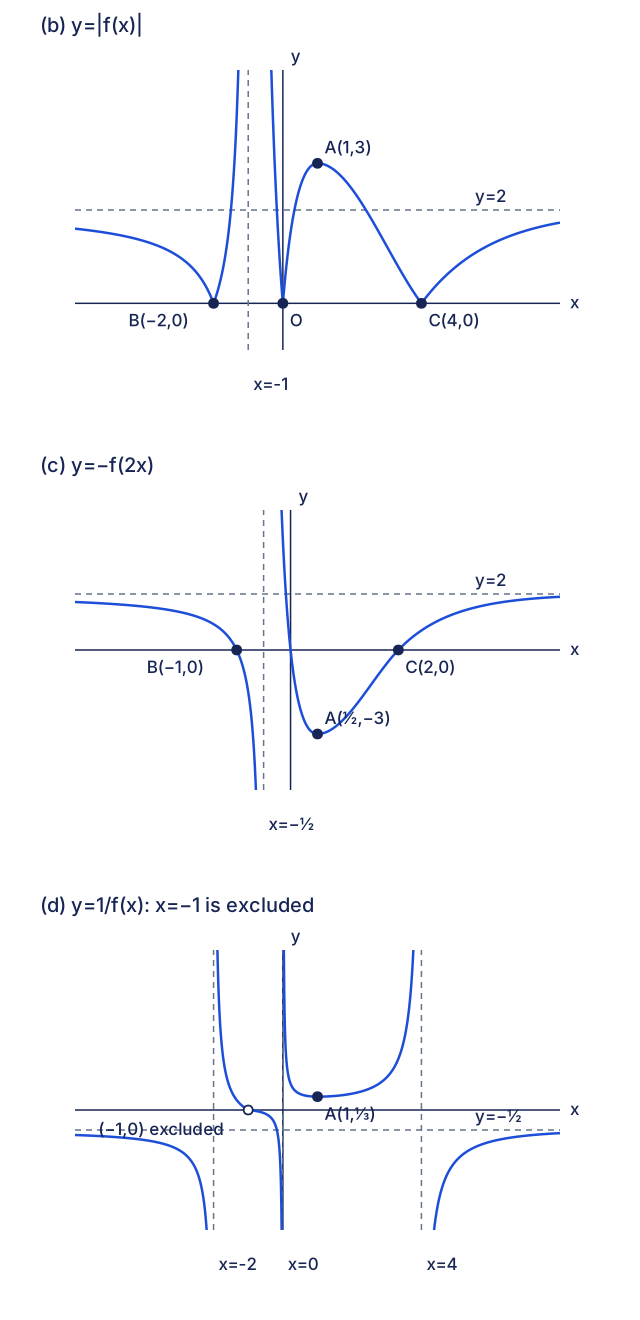
(a)(1,2). (b) A(1,3), B(−2,0), C(4,0), asymptotes x=−1, y=2. (c) A(1/2,−3), B(−1,0), C(2,0), x=−1/2, y=2. (d) Minimum (1,1/3), poles x=−2,0,4, horizontal y=−1/2; open point (−1,0), no axis intercept.
(a) Map the turning-point ordinate
, so A′=(1,2), as printed.
(b) Reflect only negative ordinates upwards
preserves A=(1,3), B=(−2,0), C=(4,0) and O. All values become nonnegative; the zero crossings become sharp local minima where the branches change sign. Vertical asymptote x=−1 remains, with both sides upward. The horizontal asymptote is y=2.
(c) Compress horizontally and reflect vertically
The point map is . Thus A′=(1/2,−3), B′=(−1,0), C′=(2,0), and O remains. The asymptotes become x=−1/2 and y=2.
(d) Convert zeros to poles and the maximum to a minimum
The zeros at x=−2,0,4 give reciprocal vertical asymptotes there. A becomes the minimum (1,1/3) on its positive branch. The horizontal asymptote becomes y=−1/2. The original vertical-asymptote input x=−1 stays excluded: its reciprocal zero limit must be drawn as an open point (−1,0). There is no true x-intercept and no y-intercept, since f(0)=0.
Compare your sketch
Expand diagramFit diagram to page
Use the scrollbars or arrow keys to inspect details.
Common mistakes
The source reciprocal sketch labels (−1,0) as a crossing, but the original f is undefined at x=−1. Retain the domain exclusion.
Solution notes
The standalone solution PDF omits the original graph referred to in its prompt. That original is present in the lecture Student PDF 38 / printed 110 and Teacher PDF 39 / printed 111; direct comparison confirms the reconstruction’s labelled features and branch directions. The original absence is retained as scoped historical evidence, not claimed for the lecture copies. The reciprocal axis-crossing ambiguity remains explicitly corrected with an open point.