Worked solution
Distinguish an absolute input from the order of affine transformations
(a) The supplied graph has asymptotes y=0, y=2, x=−1, x=1, maximum (3,3), minimum at O and the right zero (2,0) shown. Sketch:
(i) ; marks
(ii) . marks
(b) Alfred and Betty are to transform to , with original and target .
Alfred’s steps, in order: 1.Scale parallel to y by 5; 2.Translate down 3; 3. Scale parallel to x by 1/2; 4. Translate along x by −1.
Betty’s steps, in order: 1.Translate along x by −1; 2. Scale parallel to x by 1/2; 3. Scale parallel to y by 5; 4. Translate down 3.
One person made an error in one step.
(i) Identify the person and incorrect step. marks
(ii) Give the final equation resulting from that incorrect sequence. mark
Expand diagramFit diagram to page
Use the scrollbars or arrow keys to inspect details.
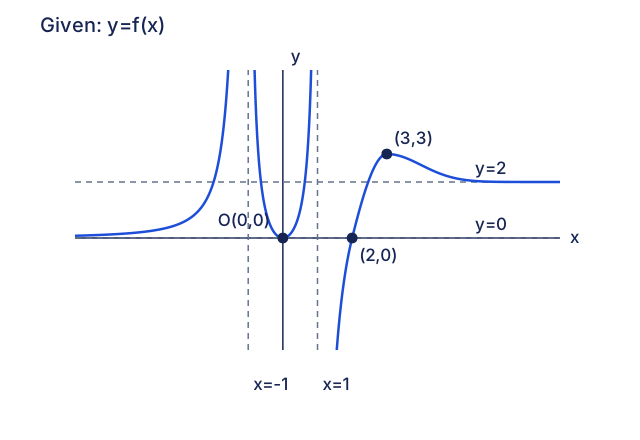
[2012/SAJC/Promo/10]
CJC · Review problems · Question 8
Answer
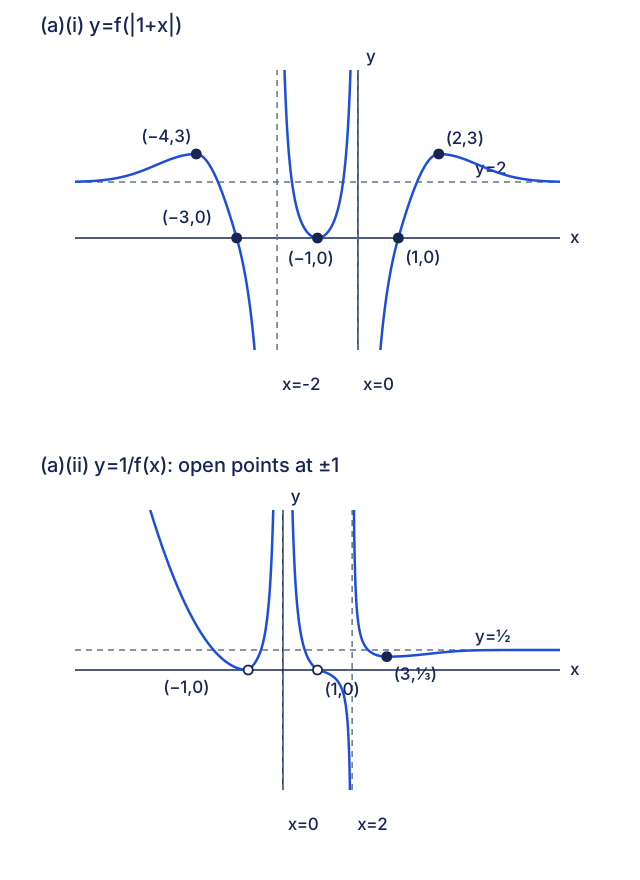
(a)(i) Symmetry x=−1, poles x=−2,0, maxima (−4,3), (2,3), minimum (−1,0), other zeros −3,1, y=2.
(ii) Poles 0,2, right asymptote y=1/2, minimum (3,1/3), open points (±1,0). (b) Alfred Step 4; incorrect result .
(a)(i) Start with the shifted input, then take its absolute value
Let u=|1+x|≥0; retain the original f branch for nonnegative inputs and reflect it about x=−1. The new graph is symmetric about x=−1. The source pole u=1 gives x=−2,0; the horizontal asymptote is y=2 at both ends. The source maximum u=3 gives (−4,3), (2,3). The original minimum u=0 gives (−1,0). The source zero u=2 gives (−3,0), (1,0).
(a)(ii) Reciprocate without filling excluded inputs
Zeros of f at 0,2 give vertical asymptotes x=0,2. The maximum (3,3) becomes the minimum (3,1/3). The right horizontal asymptote is y=1/2; as x→−∞, f→0+, so 1/f grows without bound. Original pole inputs x=−1,1 remain excluded, with open limiting points (−1,0), (1,0). They are not actual x-intercepts. There are no axis intercepts, since f(0)=0.
(b)(i) Identify the incorrect ordered step
Alfred’s Step 4 is incorrect: after horizontal scaling by 1/2, the required horizontal translation is −1/2, not −1. Betty’s sequence correctly gives .
(b)(ii) Follow Alfred’s actual operations
For , Alfred obtains , then , then , then . This is the printed incorrect final graph.
Compare your sketch
Expand diagramFit diagram to page
Use the scrollbars or arrow keys to inspect details.
Common mistakes
f(|1+x|) is not f(1+|x|). The source reciprocal sketch’s unmarked zero-limit locations at ±1 must remain excluded.
Solution notes
All (a)/(b) asks, both students’ complete four-step sequences, source graph features and source conclusion retained. Input absolute-value bars restored by comparing the PDF image; extraction omits them. Reciprocal domain holes at ±1 are explicit. Both source solution sketches reconstructed.