A hint to get started
Distinguish an absolute input from the order of affine transformations
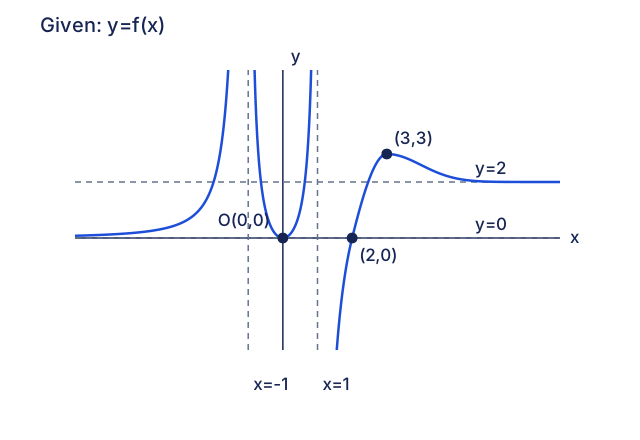
(a) The supplied graph has asymptotes y=0, y=2, x=−1, x=1, maximum (3,3), minimum at O and the right zero (2,0) shown. Sketch:
(i) ; marks
(ii) . marks
(b) Alfred and Betty are to transform to , with original and target .
Alfred’s steps, in order: 1.Scale parallel to y by 5; 2.Translate down 3; 3. Scale parallel to x by 1/2; 4. Translate along x by −1.
Betty’s steps, in order: 1.Translate along x by −1; 2. Scale parallel to x by 1/2; 3. Scale parallel to y by 5; 4. Translate down 3.
One person made an error in one step.
(i) Identify the person and incorrect step. marks
(ii) Give the final equation resulting from that incorrect sequence. mark
Expand diagramFit diagram to page
Use the scrollbars or arrow keys to inspect details.
[2012/SAJC/Promo/10]
CJC · Review problems · Question 8
Keep the absolute-value bars around the whole input 1+x, then evaluate the original f only at nonnegative arguments.