Worked solution
Use prism geometry to choose line and plane directions
Prism ABCDEF has rectangular base ABEF. Triangles ABC, DEF are congruent and perpendicular to the base. A,C have position vectors , . The unit vector in the direction FE is and BC has equation , λ real. Find:
(i) a vector equation of AB and the position vector of B; marks
(ii) an equation of plane ABC in the form ; marks
(iii) a vector equation of BE; marks
(iv) the position vector of the perpendicular foot from C onto plane ABEF. marks
Expand diagramFit diagram to page
Use the scrollbars or arrow keys to inspect details.
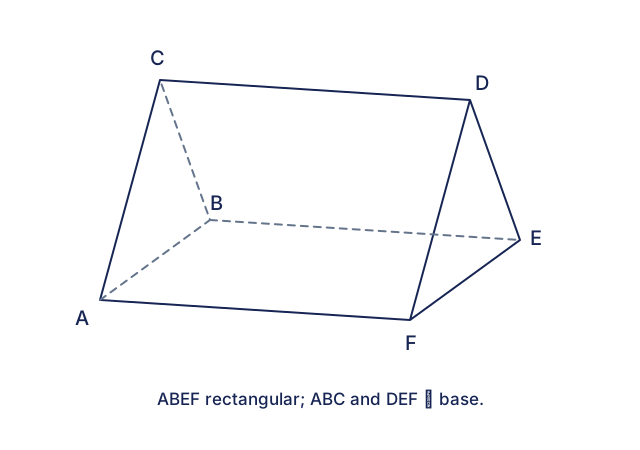
[2010/MJC/Promo/12]
CJC · Review problems · Question 2
Answer
; ; plane ; ; .
(i) Intersect the lines AB and BC
AB is parallel to FE, so . Equate this to the given BC equation: , , . Solving gives λ=−1, μ=2, so .
(ii) Cross two directions in ABC
Use BC’s direction and AB’s direction: . With A, .
(iii) Justify a normal direction using the rectangular base
BE lies in the base and is perpendicular to AB because ABEF is rectangular. Plane ABC is perpendicular to the base along AB, so this base direction BE is normal to ABC. Hence , α real. Merely lying in the base would not by itself establish this normal direction.
(iv) Reduce the plane foot to a foot on AB
Since plane ABC is perpendicular to the base along AB, the perpendicular from C to the base meets AB. Put , so . The condition gives , , μ=14/19. Thus .
Common mistakes
A line lying in one plane is not automatically perpendicular to another plane. The rectangular-base and perpendicular-face conditions supply the missing geometry.
Solution notes
Every printed ask and equation retained; source prism independently reconstructed. Source explanation for (iii) is expanded to use the full geometry rather than asserting a normal from base membership alone.