Review practice · Section 1 of 3
Questions 1–6 in this collection
Build an intersection line and a perpendicular plane · Use prism geometry to choose line and plane directions · +4 more
- 1
Planes have equations , . A=(7,2,0), O is the origin.
(i) Verify A lies in both planes. mark
(ii) They meet in line L. Show that a vector equation of L is , . marks
(iii) B=(7,−4,9), and N is its perpendicular foot onto . Find N. marks
(iv) Find the Cartesian equation of containing L and perpendicular to . marks
[2008/SRJC/Promo/15]
CJC · Review problems · Question 1
- 2
Prism ABCDEF has rectangular base ABEF. Triangles ABC, DEF are congruent and perpendicular to the base. A,C have position vectors , . The unit vector in the direction FE is and BC has equation , λ real. Find:
(i) a vector equation of AB and the position vector of B; marks
(ii) an equation of plane ABC in the form ; marks
(iii) a vector equation of BE; marks
(iv) the position vector of the perpendicular foot from C onto plane ABEF. marks
Expand diagramFit diagram to page
Use the scrollbars or arrow keys to inspect details.
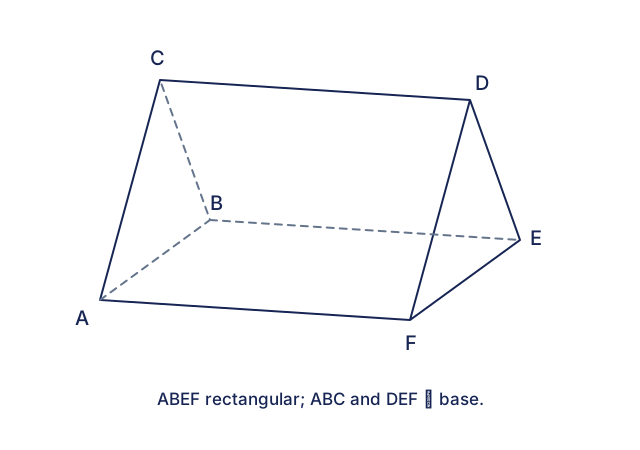
Prism ABCDEF: base ABEF is rectangular, triangles ABC and DEF are congruent and perpendicular to the base. Corresponding edges AF, BE, CD are parallel. Hidden edges AB, BC, BE are dashed. This is a perspective schematic retaining all source vertex labels and incidences, not a projection of the supplied coordinates. [2010/MJC/Promo/12]
CJC · Review problems · Question 2
- 3
Plane Π has equation . Line l passes through P with position vector and is parallel to .
(i) Find the perpendicular distance from the origin to Π. marks
(ii) Find the acute angle between l and Π. marks
(iii) Find the position vector of the perpendicular foot from P to Π. Hence find the position vector of P’s reflection in Π. marks
[2007/IJC/I/10(modified)]
CJC · Review problems · Question 3
- 4
Planes are , .
(i) Find their acute angle. marks
(ii) Obtain a vector equation of their intersection line . marks
Another line is , y=m, where m is real.
(iii) If Π1 and l2 intersect at (6,m,5), find m. marks
(iv) Show l1 and l2 are perpendicular for all m. marks
[2010/DHS/II/4(modified)]
CJC · Review problems · Question 4
- 5
Line l is , and plane p1 is . Plane p1 contains l.
(i) Show a=1. marks
Plane p2 passes through E=(−2,−5,8) and meets p1 in l.
(ii) Find the Cartesian equation of p2. marks
(iii) Find N, the perpendicular foot from E to p1. marks
Plane p3 contains E,N and does not intersect l.
(iv) Find its Cartesian equation. Hence find the distance from l to p3. marks
[2012/AJC/Promo/10(modified)]
CJC · Review problems · Question 5
- 6
(a) Plane Π passes through A=(2,0,0) parallel to and .
(i) Find Π in scalar-product form and verify B=(6,−5,1) lies on it. marks
(ii) Find the position vector of the perpendicular foot from C=(−2,1,−3) to Π. marks Hence find the equation of a parallel plane Π1 such that C is equidistant from Π and Π1. marks
(b) Line l and plane P are , λ real, and , with u,v nonzero and nonparallel.
(i) Show l is contained in P. marks
(ii) For u=(−1,2,1), v=(3,−3,2), find a line in P perpendicular to l through the origin. marks
[2008/MJC/Promo/11]
CJC · Review problems · Question 6