Vectors: planes, normals and distances
Practice section 5 of 7
Questions 25–30 in this collection
Practice questions
Discussion practice · 1 of 6
Project a pyramid shadow under two different lighting models
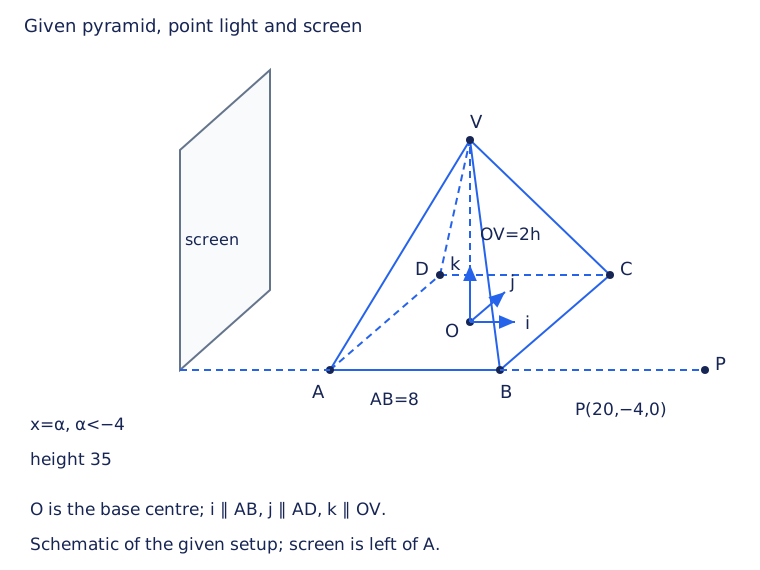
A right opaque pyramid has square base ABCD at ground level, centre O and vertex V. Perpendicular unit vectors point along AB, AD, OV, respectively. AB has length 8 and OV has length 2h. A point light source is at . A screen of height 35 has its base on the ground and lies in , where , as shown.
(i) Find a vector equation for the line depicting the light ray from P to V, in terms of h. [2]
(ii) Find an inequality between so the pyramid’s shadow does not exceed the screen height. [3]
The point light is now replaced by parallel light rays perpendicular to the screen; also .
(iii) Find the exact length of the shadow cast by edge VB on the screen. [3]
A mirror is placed on plane VBC.
(iv) Find a vector equation of plane VBC and hence the mirror’s inclination to the ground. [4]
Expand diagramFit diagram to page
Use the scrollbars or arrow keys to inspect details.
[2017/RI/I/11]
CJC · Discussion · Question 10
Solution
Review practice · 2 of 6
Build an intersection line and a perpendicular plane
Planes have equations , . A=(7,2,0), O is the origin.
(i) Verify A lies in both planes. [1]
(ii) They meet in line L. Show that a vector equation of L is , . [2]
(iii) B=(7,−4,9), and N is its perpendicular foot onto . Find N. [3]
(iv) Find the Cartesian equation of containing L and perpendicular to . [3]
[2008/SRJC/Promo/15]
CJC · Review problems · Question 1
Solution
Review practice · 3 of 6
Use prism geometry to choose line and plane directions
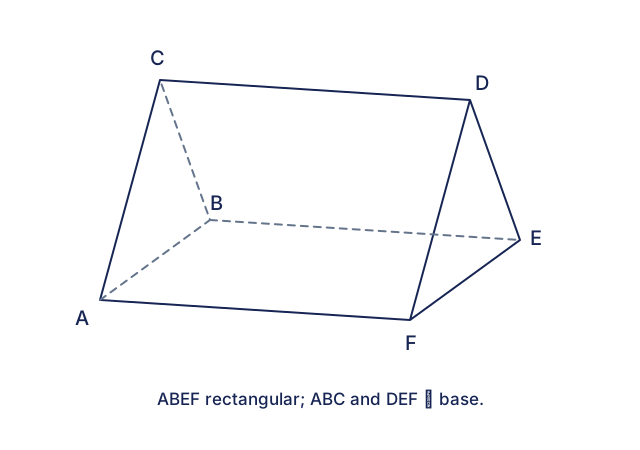
Prism ABCDEF has rectangular base ABEF. Triangles ABC, DEF are congruent and perpendicular to the base. A,C have position vectors , . The unit vector in the direction FE is and BC has equation , λ real. Find:
(i) a vector equation of AB and the position vector of B; [3]
(ii) an equation of plane ABC in the form ; [3]
(iii) a vector equation of BE; [2]
(iv) the position vector of the perpendicular foot from C onto plane ABEF. [4]
Expand diagramFit diagram to page
Use the scrollbars or arrow keys to inspect details.
[2010/MJC/Promo/12]
CJC · Review problems · Question 2
Solution
Review practice · 4 of 6
Find a line-plane angle and reflect a point
Plane Π has equation . Line l passes through P with position vector and is parallel to .
(i) Find the perpendicular distance from the origin to Π. [3]
(ii) Find the acute angle between l and Π. [3]
(iii) Find the position vector of the perpendicular foot from P to Π. Hence find the position vector of P’s reflection in Π. [6]
[2007/IJC/I/10(modified)]
CJC · Review problems · Question 3
Solution
Review practice · 5 of 6
Separate plane angles, intersections and orthogonal directions
Planes are , .
(i) Find their acute angle. [2]
(ii) Obtain a vector equation of their intersection line . [2]
Another line is , y=m, where m is real.
(iii) If Π1 and l2 intersect at (6,m,5), find m. [2]
(iv) Show l1 and l2 are perpendicular for all m. [2]
[2010/DHS/II/4(modified)]
CJC · Review problems · Question 4
Solution
Review practice · 6 of 6
Construct a plane parallel to a line and measure their separation
Line l is , and plane p1 is . Plane p1 contains l.
(i) Show a=1. [2]
Plane p2 passes through E=(−2,−5,8) and meets p1 in l.
(ii) Find the Cartesian equation of p2. [3]
(iii) Find N, the perpendicular foot from E to p1. [3]
Plane p3 contains E,N and does not intersect l.
(iv) Find its Cartesian equation. Hence find the distance from l to p3. [4]
[2012/AJC/Promo/10(modified)]
CJC · Review problems · Question 5